
Seeding progress advances to 73 per cent complete

Saskatchewan Crop Report for the week ending May 20

Seeding progress is quickly advancing across the province, thanks to very few disruptions in the weather and relatively good seeding conditions. Seventy-three per cent of the crop is now seeded, up from 38 per cent last week and well ahead of the five-year average (2014-2018) of 59 per cent for this time of year. Crops […] Read more

Emptying the tool box on fusarium head blight

Emptying the tool box on fusarium head blight

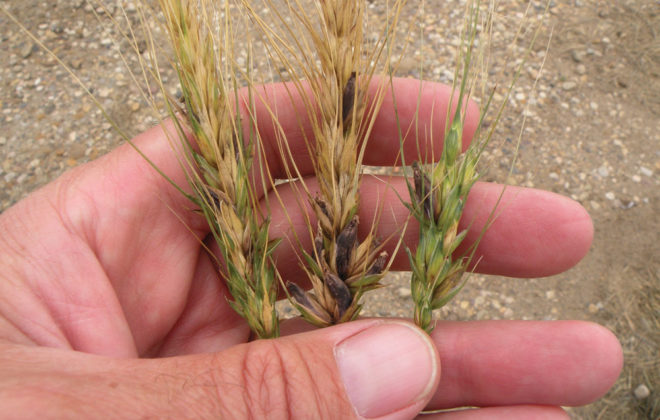
There are no silver bullets, but these 11 agronomic practices can help

While there is no so-called cure for fusarium head blight a whole series of proper agronomic practices can be applied to stave off the impact of the disease, say Agriculture and Agri-Food Canada researchers. Using FHB-resistant cereal varieties and applying registered fungicides is part of the story say Kelly Turkington, plant pathology researcher in Lacombe, Alta., and […] Read more


U.S. cattle herd still growing, but at a slower pace

U.S. cattle herd still growing, but at a slower pace

Market Update: Numbers indicate we're still a couple of years away from contraction

The USDA cattle inventory report in late February showed cattle inventory and calf numbers were above a year ago, but the expansionary phase appears to be slowing. Canadian feeder cattle exports to the U.S. for 2018 had a year-over-year increase of 65 per cent. The larger U.S. calf crop may temper demand for Canadian feeder […] Read more

Cover crop growing after harvest.

Why didn’t my cover crop work?

Kevin Elmy lists nine potential causes of things that could go wrong when you try growing cover crops on your farm

Ever try something and it didn’t work the first time? What’s the next step? Try again doing the same thing, modify the approach or give up? Ideally, getting a mentor or someone with experience to find out what went wrong will help create a successful situation. Or maybe it just doesn’t work. Cover cropping is […] Read more


Berith, Jonas Karl and Bernd Klänhammer.

Meet your farming neighbours: Bernd Klänhammer

Bernd Klänhammer’s 200-year old family farm was lost in the 50s, then regained

Every farm has its own story. No two farms (or farmers) are exactly alike. Everyone got started in a different way, and every farm has a different combination of family and hired staff who make the decisions and keep things running. But, in general, even after you consider all of the details, farmers are more […] Read more

Sunset in wheat field, late afternoon in wheat field - dusk in the cereal field

Copper: For peat’s sake!

Think peaty soil isn’t worth farming? Just add copper to get better results

Peat is nature’s natural organic compost. As a field crop amendment, peat has a lower carbon-to-nitrogen ratio (C:N), 60:1, than straw or cattle manure — that’s around 80:1. Canada has 270 million — yes, million — acres of peat lands, making up 25 per cent of the world’s peatland supply. Peat is harvested right across […] Read more


Soybean and flax intercrop example.

Reducing inputs through intercropping

In Part 2 of a 2-part series, a panel of farmers discuss the benefits of intercropping

Many producers who adopt intercrops and cover crops are looking to increase soil and plant health and reduce the need for inputs such as synthetic fertilizers. That effect often becomes clearer the longer they manage the system. The three producers on a panel at an Intercropping Workshop in Brandon, Man., last November shared how they […] Read more

Can copper reduce ergot levels in wheat?

Can copper reduce ergot levels in wheat?

Q & A with Nutrien Ag Solutions

Q: Can the application of copper reduce ergot levels in wheat? A: Ergot is a worldwide disease that affects cereal crops such as wheat, barley, triticale, rye, and oats. Ergot is promoted in years with cool, damp weather conditions in late spring and early summer. When a crop is under stress, the flowering period is […] Read more


The family at Friendly Acres Seed Farm. Kevin Elmy and his wife Christina, Kevin’s parents, Robert and Verene, and Kevin and Christina’s daughters, Kennedy and Haley.

Friendly Acres 2018 year in review

Changes are in store for Friendly Acres, but soil health will still be the top priority

One of the challenges of farming in a continental climate is weather. That is why farmers talk about it, complain about it, and want to either get good forecasts for it or control over it. Looks like the excess water issue that we had for eight years solved itself. Two years of below-normal moisture has […] Read more

Is it possible to do a better job with less land?

Intercropping lets farmers do more with less

Intercropping helps farmers increase profits on fewer acres. Part 1 of a 2-part series

It’s interesting how many farmers adopting regenerative agricultural practices, like intercropping and cover crops, are either downsizing their operations, thinking about downsizing or have taken the pressure off in terms of looking for more high-priced land to expand (either to buy or rent). The three producers on a panel at an Intercropping Workshop in Brandon, […] Read more