
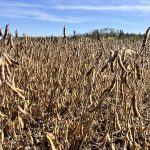
Five reasons to grow flax

Venkata Vakulabharanam, Saskatchewan Agric-ulture’s oilseed specialist, is optimistc about flax. At the Saskatchewan Flax Development Commission’s “Flax Day 2013,” Vakulabharanam gave farmers five reasons grow flax. 1. Per acre profit. According to Vakulabharanam, flax provides “equal or better profitability” when compared with other crops. 2. Better yields next year. Research has shown that canola yields better when grown […] Read more
The solution’s in the soil

Joe, a dairy farmer near Millet, Alta., who grows 900 acres of barley silage and barley for milling in a rotation with canola, had called me with his predicament in April, 2011. He’d been experiencing problems with poor emergence and a wavy-looking top to the stand had given him second thoughts about the wisdom of […] Read more


Sorting through vertical tillage, part two

Establishing a vertical tillage system on your farm means first getting rid of compaction layers. That may require some deep tillage first

Editor’s note: This is the second instalment of a five-part series. Believe it or not, that old chisel plough of yours in the back yard is a vertical tillage tool, assuming it has spikes on it as opposed to sweeps. This group of tools is used for the first step in the vertical tillage transition, […] Read more

AG PhD’s fertilizer removal app

In this new series, Jay Peterson reviews ag-related apps for iPod and iPhone. 
The first app up: fertilizer removal by crop

Editor’s note: Jay Peterson has a new iPad. He’s going to be using it to check out apps (software applications) that might be useful on your farm. Let us know if you’re looking for an app for a specific need, or if there’s an Android or Blackberry app you’d like to review. This fertilizer removal […] Read more


HOPPING HARASSERS

Byron, a Welling-area producer, called me last May, concerned about the yellow patches he’d found in his barley field. “I’m unsure what’s causing it. Given the spring we’ve had, it could be caused by frost or excess water, chemical damage or leaf disease,” said Byron. He asked me to pay a visit to his operation […] Read more

To buy or not to buy

It was April 2011 when I got a call from Joe, a dairy farmer near Millet, Alta., who grows 900 acres of barley silage and barley for milling in a rotation with canola. Joe’s frustration reverberated down the line. Continuously poor yields were affecting the purchase value of the land, and before purchasing it he […] Read more


Baling and fertility

In the not-too-distant past, it used to be that farmers gave their straw away for free. That is no longer the case. John Heard, of Manitoba Agriculture, Food, and Rural Initiatives (MAFRI), has been doing soil fertility extension work in Manitoba for about 16 years. These days, Heard said, “There’s an appreciation that there are soil nutrients in straw — about a third of […] Read more

Chloride response in canaryseed

Potassium generally gets more attention than chloride, but new 
research shows chloride can really increase canaryseed yields

Saskatchewan has half the world’s potash reserves and typically produces 30 per cent of the global supply, according to Saskatchewan’s Ministry of the Economy. Potassium chloride is the most common potash type used. While both potassium and chloride are essential plant nutrients, concerns over potassium levels often trump chloride. But new research shows chloride elicits a significant yield […] Read more


Panel optimistic about 2013

While all is looking good for the coming growing season, farmers say they are familiar with the adage “no one ever lost a crop in January”

It may be too wet, or too dry in some regions this winter, but farmers contacted for the early January 2013 Farmer Panel are optimistic about the year ahead. New equipment in the field, changes in rotation, more wheat in rotation and farming more acres, are among the changes farmers have planned for the coming […] Read more

Reading soil test results

Get the most out of your soil test results by looking at the details 
on the results page and following these six tips

Farmers primarily use soil tests to figure out how much fertilizer they need to apply each season. But more value can be gained from those test results. The first thing most farmers look at is the balance of nutrients. The soil test outlines which nutrients are deficient in the soil and which ones are sufficient. […] Read more