
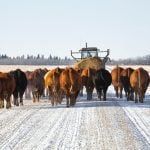
(JPNM/iStock/Getty Images)

Saskatchewan to top up some claims for wildlife-damaged forage

Affected producers in southwestern, west-central areas eligible

Producers in southwestern and west-central Saskatchewan who lost stacked forage to wildlife feeding last winter may see a bump up in their compensation. The Saskatchewan and federal governments on Wednesday announced a “supplemental freight adjustment” to their wildlife damage compensation program, administered by Saskatchewan Crop Insurance Corp. (SCIC). SCIC, the province said, has “reassessed and […] Read more

A typical brome grass field of the many I drive by on the way to Dundurn Farm. In wet years, there are many bales and in dry years only a few bales. The rain or soil moisture is always needed but if fertility is missing, wet years become ordinary years not high-yield years.

Les Henry: New wrinkles when fertilizing grass crops for hay and pasture

One quarter section of fertilized grass could give the same yield as five quarters of “cut what is there”

There are many old grass stands that are mainly brome grass and serve as hayfields with occasional grazing. Many hayfields have never seen a kernel of fertilizer. Perhaps this piece will start folks thinking and will lead to a change in practice. There are many old reports that deal with the topic. The two main […] Read more


Native prairie near Hanley, Sask.

Restoring native prairie in Saskatchewan through reverse auction

Glacier FarmMedia – Tom Harrison is on a mission to reverse the tide of native prairie being converted to cropland in Saskatchewan. It’s not an easy task. Several factors are working against efforts to conserve, let alone restore, native prairie. Economics favour farming over ranching. Government programs and policies have encouraged farmers to cultivate the […] Read more

Even without increasing the cow herd size, enhanced grazing management can pay dividends by extending the grazing season.

The importance of giving grass a vacation

A properly managed rest period should lead to increased forage production

Often the largest category of costs in a cattle operation is what economists consider fixed costs. These are usually big things such as tractors or land. In most cases, land is the largest cost item in a farm operation. On the other side of this equation are what we refer to as variable costs. These […] Read more


Plan a year or two ahead of planting a perennial forage blend.

Picking a perennial forage blend

Q & A with an expert

Q: How do I choose the right perennial forage blend for my farm? A: Growers should consider several factors when doing this. The first step is to start planning a year or two ahead of planting a perennial forage blend. Part of that planning is making sure weed control is taken care of for both […] Read more

File photo of a cow grazing near Leader, Sask., about 85 km south of Kindersley. (James_Gabbert/iStock/Getty Images)

Saskatchewan holds Crown grazing rents at last year’s levels

Also, leaseholders on drought-downgraded land eligible for rate cut

Cattle producers leasing Crown land for grazing in Saskatchewan won’t see a rate hike this year and may be eligible for a significant rate cut. The provincial government announced Wednesday it has frozen the rates charged to producers who lease Crown grazing land in 2023 at their 2022 level. The freeze will apply to all […] Read more


The Fossen family of Rock Creek, B.C. — Doug and Erika and daughters
Adele, Jade and Reine operate Bar 7 Ranch. Their commitment to
sustainable ranching practices earned them recognition with The
Environmental Stewardship Award (TESA) presented by the Canadian
Cattle Association.

Rotational grazing key to ranch success

The plan is to use each pasture only once during the grazing season

For the Fossen family of south-central British Columbia, applying proper stewardship to forage and water management on their private land as well Crown range pastures not only benefits the environment but ultimately makes good business sense for their ranching operation. As the second and third generation on the Bar 7 Ranch near Rock Creek in […] Read more

Different materials can be used to
cover hay, but properly secured
black plastic works well particularly
because snow slides off easily.

Tips for protecting hay quality over winter

Research shows single bale rows are better than a pyramid stack

Several methods can help preserve feed quality and reduce moisture damage in your winter hay supply. Warren Rusche, feedlot and beef management specialist with South Dakota State University, says the ideal way to store hay is under cover in a shed, but this works best for square bales. It’s usually not practical for round bales […] Read more


(File photo)

Manitoba to cut Crown forage lease rates

Previous years' forage conditions a factor, province says

The rents paid by Manitoba producers using Crown lands to produce perennial forages will be cut in half next year and by smaller amounts the following two years. Provincial Ag Minister Derek Johnson on Wednesday announced the forage lease rent on agricultural Crown land will be reduced by 50 per cent in 2023, 33 per […] Read more

Economic and ecological benefits of annual forages

Economic and ecological benefits of annual forages

Q & A with an expert

Q: What can I do with my unseeded acres now the weather is more favourable?  A: Flooding and drought at seeding time are common situations that may lead to acres being unseeded to previously planned high-value crops. While crop insurance can provide varying levels of compensation for acres unseeded to long-season cash crops, sometimes opportunities […] Read more