The 2019 harvest on the Prairies left little to be desired, with crops still left in fields for a good number of farmers.

Speeding up crop maturity

Consider these nine factors to make sure you have time to get your crop in the bin in 2020

Last season, 2019, was a bad crop-growing season on the Canadian Prairies. There are various estimates of 10 to 25 per cent of all crops left unharvested in swaths or even still standing on cropland. Well, in that case, 75 to 90 per cent of the crop is in the bin, despite the weather. Lots […] Read more


The affected plants had smaller peas than they should, and some leaves were exhibiting minor ascochyta blight damage.

Crop advisor casebook: What’s causing the symptoms in this ailing pea crop?

A Crop Advisor's Solution from the February 11, 2020 issue of Grainews

Andy has a 2,000-acre mixed farm operation near Vauxhall, Alta., where he raises cattle and grows wheat, canola, sugar beets, beans, field peas and hay. I had worked with Andy for some time and knew he’d stepped up his scouting efforts that summer, due to the fact the growing season had been unusually cool and […] Read more

Drone provides a new field perspective

Drone provides a new field perspective

Ground truthing is still important, but drones can identify problem areas

Randi Wenzel says even basic operation of a drone over annual crops and pastures on their south-central Saskatchewan mixed farm provides some very useful management information, along with some peace of mind. Wenzel, who farms with family members south of Central Butte, has been flying a drone during the cropping and grazing seasons for the […] Read more


Farming Smarter has been looking at the potential of precision planters for grain, pulse and oilseed crops for several years.

Precision planter research is encouraging

Still many questions about how it would fit for grains, pulses and oilseed crops

Southern Alberta researchers say there is increasing evidence that seeding a wide range of western Canadian field crops with a vacuum or precision planter makes sense, but they need co-operative weather to prove it. That’s how Ken Coles and Lewis Baarda with the Lethbridge-based Farming Smarter applied research organization sum up results of several years […] Read more

Farmers take a look at smaller-scale plots on a tour of the research farm at Carman, Man., in the summer of 2019.

Testing the cover crop hypothesis

Agronomy researchers are catching up with what farmers are doing in their fields

It’s an exciting time for cover crop research. Last summer, many large-scale cover crop trials were underway across the Prairies looking at everything from cover crop combinations, rotations and planting methods to pollinator strips. One of the biggest ongoing projects, funded by Western Grains Research Foundation, Manitoba Wheat and Barley Growers and Manitoba Pulse and […] Read more


Jeff’s durum crop was patchy and uneven. Most of the affected areas were on the tops of knolls within the field.

Crop advisor casebook: Why is this durum crop patchy, uneven and with discoloured leaves?

A Crop Advisor's Solution from the February 4, 2020 issue of Grainews

Jeff, a mixed grain and livestock producer who farms near Vulcan, Alta., called me in early June about a problem in one of his durum wheat fields. Earlier that day, Jeff had noticed the crop looked patchy and uneven while driving by the field. When he walked into the field to investigate, he could see […] Read more

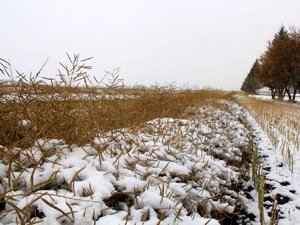
File photo of canola under snow in October 2016. (Lisa Guenther photo)

Unharvested crops skew StatsCan stocks data

MarketsFarm — Canadian canola stocks were slightly tighter at the end of the 2019 calendar year compared to the previous year, according to updated Statistics Canada data. However, adverse harvest conditions left a large amount of the crop unaccounted for in the survey, which skews the overall supply/demand outlook. “Because of poor weather conditions during […] Read more