
John Deere is offering three new 9000 series forage harvesters, which use the brand’s new JD18X diesel engine.

New forage harvesters from John Deere

New 18-litre engine powers 9000 series models

Self-propelled, high-capacity forage harvesters require some serious power under their hoods. In the past, John Deere’s limited range of in-house diesel engines meant the green brand had to turn to engine manufacturers like Cummins to get enough muscle for their largest models. And while their top-end 9800 and 9900 models, which deliver 855 and 956 […] Read more
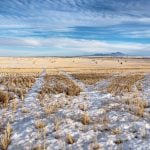
Different materials can be used to
cover hay, but properly secured
black plastic works well particularly
because snow slides off easily.

Tips for protecting hay quality over winter

Research shows single bale rows are better than a pyramid stack

Several methods can help preserve feed quality and reduce moisture damage in your winter hay supply. Warren Rusche, feedlot and beef management specialist with South Dakota State University, says the ideal way to store hay is under cover in a shed, but this works best for square bales. It’s usually not practical for round bales […] Read more


File photo of a sunrise over an Alberta barley crop. (MNphotography/iStock/Getty Images)

Alberta issues final crop report for year

Harvest over 98 per cent done by region and crop type

MarketsFarm –– For the second year in a row the Alberta harvest wrapped up well ahead of the five-year average. With a gain of three points for the week ended Tuesday, Alberta Agriculture, Forestry and Rural Economic Development (AFRED) pegged the combining of major crops at 99.2 per cent complete. That’s 22 and a half […] Read more

(Lightguard/iStock/Getty Images)

Saskatchewan crops advancing quickly

MarketsFarm — Hot and humid conditions saw crops in Saskatchewan advance quickly during the week ended Monday, according to the latest provincial crop report — although the humidity has slowed haying. When humidity is high, cutting hay becomes more challenging and hay that is cut does not dry down as quickly, which can result in […] Read more


A Canada-wide map of drought conditions. Photo credit: Canadian Drought Monitor

Drought conditions remain in Alberta, Saskatchewan

MarketsFarm — After copious amounts of precipitation alleviated the most severe drought conditions in Saskatchewan and Alberta, there were still some areas dealing with extreme dryness entering July, according to the Canadian Drought Monitor. At the end of June, only 22 per cent of the Prairie region was classified in the Abnormally Dry (D0) to […] Read more

(Lightguard/iStock/Getty Images)

Planting progress picking up in Saskatchewan

MarketsFarm — Overall spring planting across Saskatchewan reached 33 per cent complete as of Monday, according to the latest weekly crop report from Saskatchewan Agriculture. Despite the good progress over the week, that’s still 20 points behind the five-year average. When compared to the excellent progress this time last year, the gap expands to 41 […] Read more


How to produce quality hay horse owners want to buy

How to produce quality hay horse owners want to buy

Taking crops off your hay land is much the same as cropping it to wheat or canola

What is hay? Recent hamburger commercials keep referring to grass-fed beef. If you feed your cattle hay, are they still grass fed? All the year round, grass feeding occurs in very few areas of the world. In most of North America, hay is fed up to six or seven months of the year. Bison or […] Read more

(Photo courtesy Canada Beef Inc.)

Klassen: Feeder market stabilizes

Cow-calf producers selling sooner than normal

Compared to last week, western Canadian feeder cattle prices traded $2-$3 on either side of unchanged. Alberta packers were buying fed cattle on a dressed basis at $275 delivered; the Alberta fed market has rallied $10-$12 over the past couple weeks. Secondly, U.S. feeder cattle prices have also rallied US$10-US$12 during the same time frame […] Read more


The nitrate level in a sample of this grass regrowth were somewhat elevated and there was always a risk there could be some “real hot spots” in other parts of the 40 acre field.

Play it safe with high nitrates

Proper management of drought-affected forages can reduce the risk to livestock

This year’s drought taught me many lessons about the dangers of high nitrates in beef cow forage. That is why I recommend that all cow-calf producers test all their harvested forages for nitrates, whatever field it came from. It’s going to be money well spent, whether tests are negative or positive. And if they are […] Read more

(Andreus/iStock/Getty Images)

Hay-starved Prairies fertile ground for online scammers

At least $64,000 lost in Alberta alone, RCMP says

High demand, scarce supplies and rising prices for hay and other feeds due to this summer’s drought on the Prairies have made a market for online scammers, RCMP warn. The urgency driving such transactions may cause ranchers, farmers and farm workers to make purchases “without taking time to properly verify or research production sources,” Alberta […] Read more