

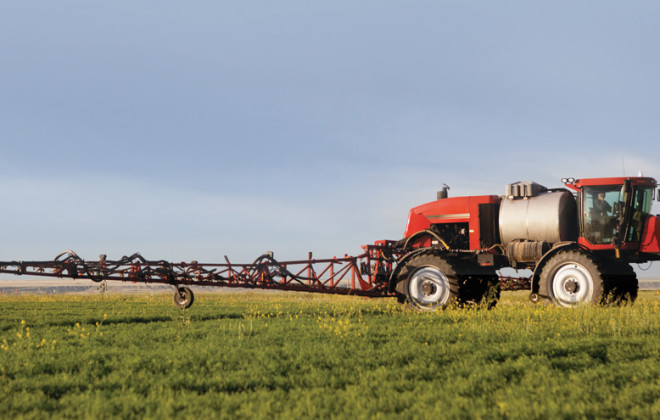
Growers should only use an insecticide when an economic threshold for a pest is reached.

Don’t jump the gun on pest control

It’s never a good idea to overreact when you see insects on your crops because jumping the gun, and spraying if it’s not really necessary, can do more harm than good. “Seldom, if ever, do preventative insecticides actually pay us,” says Scott Meers, insect specialist with Alberta Agriculture and Forestry. “When we spray just to […] Read more

flea beetle damage on a leaf

Flea beetle scouting strategies

Agronomy tips... from the field

The one nice thing about striped and crucifer flea beetles is that they’re quite easy to tell apart. And based on previous years, you should already have a fairly good idea of whether you have one or the other species in your fields. Here are few key things to remember about striped and crucifer flea […] Read more


Rape field, canola crops

8 tips to running your own crop trials

Tired of adapting other people's research to your farm? Get your own

Every acre can be a research acre, Nicole Philp told farmers at Saskatoon’s CropSphere in January. Farmers interested in testing new products and practices can create powerful data sets with a little co-ordination, said Philp, a Canola Council of Canada agronomist. But how can you make sure you get good data out of your on-farm […] Read more

The Canola Performance Trials

The Canola Performance Trials

Who pays for them? Why? Learn more about how to make the trials work for you

Do you depend on your provincial seed guides to help you make a choice about what varieties of canola you’re going to plant any given year? If so, you may be wondering, given that those great resources are available, why the Canola Performance Trials (CPT) are also important for making decisions for your particular acreage. […] Read more


flea beetles on a canola pod

Keys to flea beetle control in canola crops

Agronomy tips... from the field

The important thing to understand about flea beetles is that they overwinter as adults — and it’s those adults that do all the feeding on your seedlings come the spring. Your canola crop is most vulnerable to flea beetle feeding from the cotyledon stage at emergence up until it reaches the three- or four-leaf stage. […] Read more

Staghead disease is of relatively low risk, but certainly be watching for clubroot.

Be on guard for clubroot in canola

Hart Attacks: If it’s in your community, be on the lookout for clubroot in your canola fields this year

I’m using this photo of a flowering crop heavily hit with a pest to make the point to watch out for canola diseases this year — and in particular be on the ball to detect and hopefully prevent clubroot. This southern Alberta farm didn’t expect to be coping with staghead, but it suddenly appeared out […] Read more


Devil’s trumpet of known as Jimsonweed Flower

Look out for the Devil’s trumpet

Jimsonweed, also known as Devil’s trumpet is a highly toxic weed

According to provincial weed specialists in Alberta, jimsonweed, a highly toxic and problematic weed species, was found in three Alberta canola fields (Barrhead, Leduc and Westlock) last month. Growers are currently working with their provincial departments and the CFIA on an eradication strategy, although they are not considering it a major problem at this moment. […] Read more

Black discolouration in the stem’s cross section is a sign of blackleg.

Scouting for blackleg in canola

The Canola Council of Canada recommends blackleg scouting a week or two before straight cutting or swathing. Don’t wait more than a week after harvest, the Council advises, or plants may be too decomposed to pick out symptoms. While scouting, pull plants and clip stems below ground level. Black discolouration in the stem’s cross section […] Read more


Dallas Leduc, who farms near Glentworth, Sask., says he hasn’t run into many problems when it comes to meeting contract requirements, although year-to-year price changes can be frustrating.


The fine print on grain contracts

Lee Hart talks to seven Prairie grain farmers about their experiences 
with grain contracts

Grain contracts: they appear to be a necessary part of doing business for most western Canadian farmers, but how many actually read them? The Canadian Canola Growers Association* has published a handy and informative booklet called, “A Practical Guide to Navigate Grain Contracts.” It is a quick and easy, 21-page read which covers many of the […] Read more

Devil may be in the contract details

A grain contract should work both ways to protect the buyer as well as the seller

It may seem like just a lot of fine print, but farmers are urged to read and understand the whole document before finalizing a contract when selling any commodity, says a manager with the Canadian Canola Growers Association (CCGA).* Farmers need to know their rights, and they also need to understand any clauses that may […] Read more