This graphic, from a University of Minnesota Extension Bulletin, shows some common designs for tile drainage.

Trying tile drainage on your farm

There's information out there. Do your homework before starting tile drainage

I am not an engineer and will not give recipes for pipe size, spacing or equipment. Rather, I’ll look at the principles and steps a farmer should take before investing big bucks in tiles. Tile drainage is not a new technology. Many of the better soils of the world are on flat, low lying, high […] Read more

Soil background

The making of a healthy soil

“Soil health” is a popular topic, but Les Henry says the fine points are mostly spin

We hear a lot about soil soil health these days so thought I should brush up on the literature. To give the punch line first: in my opinion it is mostly spin. Any introductory course or soils textbook starts by picking a hypothetical pound of ground and revealing the basics. Soil is half solids and […] Read more


(click image for larger view)

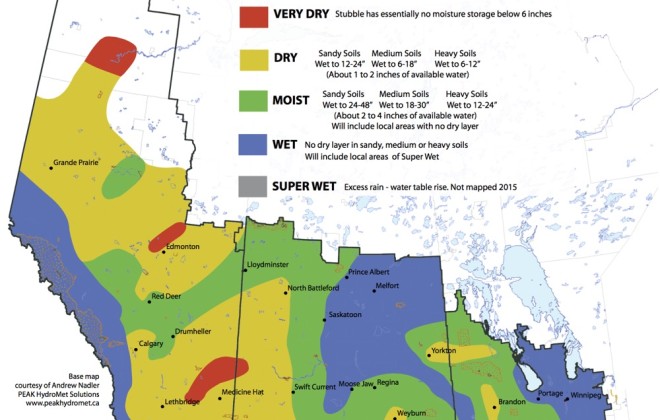
Stubble soil moisture, November 1, 2015

Les Henry’s annual soil moisture map gives us a true view of water availability

This map shows the best estimate of subsoil moisture from three inches to four feet. First — this is a map of general conditions in general areas. Do not get too hung up on the exact placement of lines. But, it is still very useful in planning for 2016 outcomes. With a soil full of […] Read more

Tile drainage in progress south of Melfort, October 2014. The water table was high and tiles were running as soon as installed. The drain outlet is Melfort Creek. This project is on the Alan Hurd farm. Mark Gordon of Agri-Trend provided the soil EC mapping of the site and Stu Brandt of NARF (Northeast Agricultural Research Foundation) installed the observation wells and is monitoring the site.

Soil salinity: causes, cures, coping

After recent wet years, we’re seeing salinity again. Learn to cure it or cope with it

A few years back we predicted that the super wet years would lead to a marked increase in soil salinity. It is now happening. In this piece I am not going to talk about Solonetzic soils or true Alkali (high pH , low salts) soils. I’m talking only about saline soils — soils that have […] Read more


On June 8, 2015, the best of the canola crop didn’t look great. I have no pictures of the worst. That was just a lot of bare ground. Who wants a picture of bare ground?

Diary of a tough year for canola

The sordid story of a Saskatchewan canola crop, from seedbed preparation to the final sale

As I was preparing to write this, the Dec. 1 issue of Grainews arrived with Lee Hart’s front page article: “Holy Canola! A 74 bushel average yield.” No 74 bushels here. My story is: the land is rolling dark brown, loam texture, glacial till with some stones and many sloughs. It has been continuous cropped […] Read more

Finding the world’s greatest fix

Finding the world’s greatest fix

A rare find in the library has given Les Henry food for thought on a cold winter evening

In the winter months I spend time in the University of Saskatchewan library and often stumble on a great book that I was not really looking for. One such find is the subject of this article. The headline for this piece has nothing to do with a needle in a back alley of a seedy […] Read more


The Kevin McGrath home near Fielding, Sask., was built by his parents Martin and Katie in 1916.

Catalogue houses: Eatons and others

Looking for information about a catalogue house in your area? Les Henry may be able to help

I have a longstanding interest in catalogue houses. In fact, I’ve written a book with the same title as this column (see below for details). My interest in mail order houses comes honestly. Seven sisters and I were raised in a large 2-½ storey square house much like many of the catalogue houses of that […] Read more

Agricultural sustainability and feeding the world

Agricultural sustainability and feeding the world

Sustainability, organic farming, and feeding the world: not as simple as they sound

Sustainability is a major ag buzzword today, mostly peddled by folks with little concept of what a farm is. It is being used in both crop and animal production but I will just talk about crops. To get on the “sustainable” list to market certain crops I see very strange requirements. You must not push […] Read more


Install the well. This photo shows a well installed with a cap on top — just loose of course. This was a very clean 11 foot hole so I had to set the top with natural clay from auger leavings.

DIY: Installing water table wells

With water in the soil, we can survive on little rain. Learn how to measure what you have

2015 will go into the books as a very different kind of growing season. In central Saskatchewan we started off with soil completely full of water after a big dump of snow on April 26. My rain gauges showed 2.5 inches of water when it all melted. And then Mother Nature turned of the tap […] Read more

This photo and the one further down are of the canola on my “breaking” land — recently broken land (this is only the second time its been under a seed drill). The pictures were taken on July 27, 2015. In fall 2014 the soil test N in this field was only 20 lbs./acre to one foot but the zero to six inch level organic matter was 6.5 per cent. The “normal” areas in this field got 94 lbs. N/acre as anhydrous. This area got only the 20 lbs. N/acre as broadcast 21-0-0-24. Obviously, mineralization is providing much of the N. My zone fertilization plan involves telling the custom applicator to leave out the breaking and salty ground. It works!

Soil: Test the right pound of ground

If you don’t measure what you have, you can’t know what to add. Know the basics of taking soil tests

First, some general tips around soil testing. The first thing to note about soil testing is that it is an index — it is not like a dipstick in a crankcase. A soil test (index) rates a soil as very low to excessive and is one piece of information to guide fertilizer use. But, use […] Read more