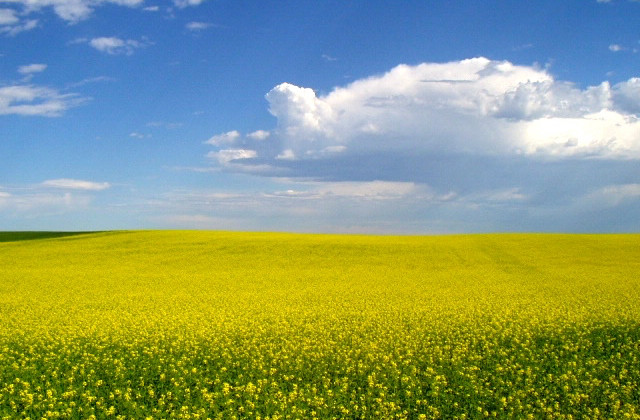
Topsoil moisture conditions mostly good, warmth spurs excellent crop growth

Saskatchewan Crop Report for the week ending June 13

Seeding in Saskatchewan is expected to be completed this week, according to Saskatchewan Agriculture’s weekly Crop Report. While there are few fields of oats and flax, as well as some greenfeed and silage, being seeded at this time, 99.5 per cent of the crop is in the ground. The five-year (2011-2015) average for this time […] Read more

Deep tillage can be beneficial under specific soil conditions, but use can also have serious negative effects on soil quality.

Understanding soil compaction

Agronomy Management: How to manage each of the three main types of compaction in your fields

In the last issue of Grainews I wrote about the effects of compaction on soil. Now, I’ll discuss the specific types of soil compaction and the ways each type can be managed. 1. Surface soil crusting This type of compaction is caused by a combination of soil tillage and raindrop impact. Causes: Tillage can bury much of […] Read more


Five Q and As on soil testing

Five Q and As on soil testing

Here’s what you need to know to make sure your plants have all the right nutrients

Soil testing will help you give your crop the best possible start. Dr. Jeff Schoenau, soil fertility expert at the University of Saskatchewan, delivered a free webinar on soil earlier this winter. Schoenau had answers to five common questions about soil testing and fertility.

This is a water well map for part of Tp 29 R13 W3, west of Milden, Sask. Legend: The “A”s next to well locations indicate that these wells date from before the survey, pre-1935. For the 2 wells that show a number instead of an A, the 74 and 70 indicate the year the well was dug. Next to the A or year, the top number shows the depth to water in the well (in feet); the bottom number shows the depth of the well (in feet). Where the circle is black, the well is assumed to be located next to buildings. Clear circles indicate that the well location is unknown within the quarter section.

The “other” moisture

Surface moisture is easy to measure: Moisture from the water table is another story

In making soil moisture maps as of freeze up the past few wet years, I have come to realize that we should have maps of areas where the surface moisture that we grow crops with has little or no connection to the water table. This piece adds a bit to that idea. In the 1980s […] Read more


The effects of soil compaction

The effects of soil compaction

In the first of a two-part series, learn how to diagnose soil compaction in your field

Soil compaction can be a serious form of soil degradation resulting in decreased crop production and increased risk of soil erosion. Soil compaction can reduce water infiltration into soil, crop emergence, root penetration, crop nutrient uptake and water uptake — all of which can reduce crop yields. Compaction concerns Soil compaction is caused by tillage […] Read more

Slow resistance with layered herbicides

Slow resistance with layered herbicides

Gowan representatives say layering isn't just about dressing for fickle weather anymore

Layering herbicides is a way to manage or delay herbicide resistance on the farm. The key is to apply a residual before seeding. The residual creates a herbicide layer in the soil. That layer kills weeds as they try to push emerge. With fewer weeds, there is less selection pressure on herbicides used later in […] Read more


Don’t misdiagnose soil compaction

Don’t misdiagnose soil compaction

Erosion or true compaction? A correct diagnosis is key to proper management

Subsoils are naturally compact, and what looks like a soil compaction problem might actually be a case of erosion removing the top, soft layer of soil and exposing the dense subsoil. “People assume they have a soil compaction problem, but exposed subsoil is often misdiagnosed as a soil degradation issue,” says David Lobb, a professor […] Read more

Managing mustard fertilizer

Managing mustard fertilizer

Part 3 of this 4-part series on mustard agronomy covers mustard's fertilizer needs

In the last issue of Grainews, I discussed the nitrogen needs of mustard. Now, let’s turn to the other fertilizers mustard requires. Phosphorus (P) About 80 per cent of brown and dark brown soils are deficient in phosphorus (P). Soil P availability to plants can be assessed by soil sampling and testing to determine plant-available […] Read more


Investing in vertical tillage tools

Investing in vertical tillage tools

Soil Management: When it comes to vertical tillage, there is no "one size fits all" for every job

Farmers struggling with excess residue, moisture, or compaction are experimenting with various forms of tillage. But many questions remain about how to best use the equipment on the market today. In the fall of 2014, the Buiten­huis and Baillargeon families ran a tillage demo at their farm near Edam, Sask. They ran seven different tillage units, plus used a […] Read more

fertilizer spreading tractor

Protected fall N improves efficiency

Nitrogen stabilizer products have a good fit where farm labour and time are limited

Dan Hacault likes to use nitrogen stabilizer products on his farm for time management, convenience, nutrient efficiency, cost effectiveness, and making it easier for him to manage seeding when working by himself… and oh, yes, on-farm field trials show his yields are holding steady as well. Hacault, who has downsized to crop about 1,300 acres […] Read more