Weather, soil moisture and crops

Weather, soil moisture and crops

Your definition of drought will depend on the amount of subsoil in your fields

My 2016 barley crop was seeded May 8 into excellent moisture at a depth of 1.0 to 1.5 inches — a bit deeper in some soft sloughs. Up to the date of seeding there had been essentially no spring rains. A May 4 burn off with 2,4-D + Glyphosate took care of the volunteer canola […] Read more

(WeatherFarm.com/weather-maps)

Timing of rain ‘ideal’ for Prairie crops

CNS Canada — Well timed weekend rains across Western Canada have benefited germinating canola crops and soil conditions — but some areas could use more moisture, one weather and crop specialist says. “In terms of the timing of the rains, they’ve been pretty well ideal,” said Bruce Burnett of G3 Canada. Showers over the week […] Read more


Water level changes in a shallow (35 foot) observation well near Melfort, Sask.  1967 – 2016.

Climate and weather cycles

There have always been climate cycles. The question is "Where are we now?"

One of the biggest topics for discussion in recent years is climate change and how we have to shut down the world as we know it to keep alive in the future. On the CO2 and fossil fuel issue Canada is a rounding error. It is all about China. And China must change. Not so […] Read more

(click image for larger view)

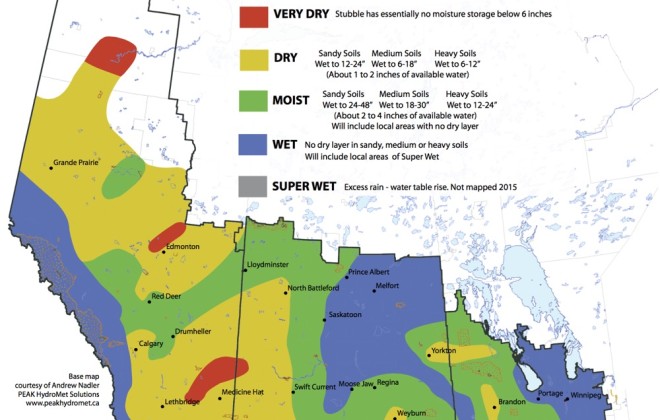
Stubble soil moisture, November 1, 2015

Les Henry’s annual soil moisture map gives us a true view of water availability

This map shows the best estimate of subsoil moisture from three inches to four feet. First — this is a map of general conditions in general areas. Do not get too hung up on the exact placement of lines. But, it is still very useful in planning for 2016 outcomes. With a soil full of […] Read more


On June 8, 2015, the best of the canola crop didn’t look great. I have no pictures of the worst. That was just a lot of bare ground. Who wants a picture of bare ground?

Diary of a tough year for canola

The sordid story of a Saskatchewan canola crop, from seedbed preparation to the final sale

As I was preparing to write this, the Dec. 1 issue of Grainews arrived with Lee Hart’s front page article: “Holy Canola! A 74 bushel average yield.” No 74 bushels here. My story is: the land is rolling dark brown, loam texture, glacial till with some stones and many sloughs. It has been continuous cropped […] Read more

combine harvesting

Southern harvest well-advanced, but weather creating lodging, quality issues for some

Saskatchewan Crop Report for the week ending September 7

Forty per cent of the 2015 crop is now in the bin and an additional 33 per cent is swathed or ready to straight-cut, according the Saskatchewan Agriculture’s Weekly Crop Report. The five-year (2010-2014) average for this time of year is 25 per cent combined. Regionally, producers in the southwest are furthest advanced, having 61 […] Read more


Sask. crops get soaked, but may take yield hit

Sask. crops get soaked, but may take yield hit

(Reuters) – Two days of rainstorms in Saskatchewan, Canada’s biggest wheat- and canola-growing province, may have done more harm to crops than good, even though farms were parched, a Saskatchewan government official said on Wednesday. Much of the province received rain on Monday and Tuesday, with the capital, Regina, collecting about 90 millimetres (3.5 inches), […] Read more


Central Alberta receives weekend rainfall

Up to two inches in some areas will help fill crops

Commodity News Service Canada — Many regions of central Alberta saw some beneficial rainfall going into the weekend, which provided some relief to dry fields and aided crops as they head into the filling stage. “What it’s basically going to do is help fill the crops. In some places they had up to two inches of rain […] Read more

Rainfall relieves some dry areas of Sask., but more needed for crops to fill out

Rainfall relieves some dry areas of Sask., but more needed for crops to fill out

Saskatchewan Crop Report for the week ending July 13

Livestock producers now have 32 per cent of the hay crop cut and 38 per cent baled or put into silage, according to Saskatchewan Agriculture’s weekly Crop Report. Hay quality is rated as four per cent excellent, 48 per cent good, 34 per cent fair and 14 per cent poor. Concerns about a potential hay […] Read more