
Three Ways To File Your Paperwork

The process to sign a Clearfield commitment form is fairly easy and simple. Often these little details slip your mind as you get busy making more concrete decisions, such as crop planing prior to heading into the field. Once seeding begins lots of these small administrative tasks take the back seat until a rainy day. […] Read more

The Top Four Weeds Most Likely To Develop Glyphosate Resistance

With the widespread use of glyphosate in North America, it was only a matter of time before glyphosateresistant weeds appeared. At the Saskatchewan Soil Conservation Association conference in 2007, Hugh Beckie said that, “When glyphosate resistance occurs (in Canada), it will likely be first reported in Ontario.” True to form, glyphosate-resistant giant ragweed was confirmed […] Read more


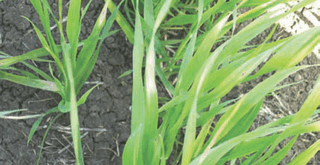
The youngest leaves were most affected and were severely yellowed in this barley crop.

Crop Advisor’s Casebook: Yellowed sixth and seventh barley leaves tell a tale

A Crop Advisor's Solution from the April 18, 2011 issue of Grainews

As Rodney drove by his field mid-June last year, he got a nasty shock. His barley crop — progressing well up until that point —was turning yellow. “I’ve never seen this in my 20 years of farming,” Rodney told me. “My barley crop is under a lot of stress,” he said. Rodney farms 1,000 acres […] Read more

Crop Advisor’s Solution – for Apr. 4, 2011

Tim’s cattle won’t be dining on corn any time soon. Last November, while fencing off a field of grazing corn, previously badly damaged by hail, this Saskatchewan producer noticed a distinctly musty smell coming from the crop. Concerned his corn was rotting due to the damage caused by the hail, Tim called me right away […] Read more


Two Seeding Season Strategies

Two relatively large Saskatchewan farmers reflect different approaches to getting the 2011 crop seeded under potentially wet field conditions this spring. Brad Hanmer who runs an extensive cropping operation with family members at Govan, and Gerrid Gust, who is part of a family farming operation at Davidson — both farms are about an hour north […] Read more

Three Strategies For Control Of Scentless Chamomile

WEED MANAGEMENT It’s a nasty weed cursed at with many names — wild daisy, scentless mayweed, false chamomile, Kandahar daisy and barnyard daisy. Scentless chamomile is an invasive weed that has a hard time decided whether it’s a summer annual, winter annual or even a short-lived perennial. The pesky weed has become a more significant […] Read more


Low Copper Tied To Ergot

The 2010 cool, wet growing season was a contributing factor to a dramatic increase in ergot in wheat and barley last year, but the real cause is likely due to a nutrient deficiency, says an Alberta-based plant pathologist. If plants are low in copper, pollen can be sterile, says Ieuan Evans, plant pathologist and senior […] Read more

This Grazing Corn Smells Off

think my grazing corn crop is rotting,” said Tim, a farmer who owns a mixed operation of cattle and grain south of Regina. He called me in early November of last year after noticing something was wrong with a half section while fencing off the crop for grazing. “The field doesn’t smell right,” he said, […] Read more


Denitrification Robbed This Wheat Of N

Blame it on the rain, as the saying goes. Last spring, heavy precipitation in Manitoba caused all sorts of problems for farmers. Doug, who farms 2,300 acres of wheat, oats, canola and soybeans south of Brunkild, was no exception. His wheat fields saw six inches of the wet stuff during the last two weeks of […] Read more

A Look At RTK-Guided Inter-Row Seeding

Like other farmers and researchers, Brett Stimson of Coaldale, Alta., hasn’t made up his mind yet about whether inter-row crop seeding makes a difference. Stimson, who farms north and east of Lethbridge, has been experimenting with inter-row seeding for the past three years. Being involved with the Rocky Mountain Case IH dealerships across Western Canada, […] Read more