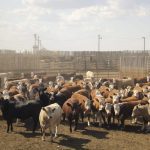
(Photo courtesy Canada Beef Inc.)

Plans afoot to move hay from East to drought-hit West

CFA, BFO spearheading Hay West-style initiatives

Farm groups are spearheading new plans to get livestock feed from Eastern Canada to drought-damaged regions of the western provinces and northwestern Ontario. Details are still pending, but the Canadian Federation of Agriculture (CFA) announced Aug. 12 it has started work on a “Hay West” initiative to get surplus hay “to those struggling in the […] Read more

Lurking nitrates and noxious weeds threaten to be yet another fly in the ointment as livestock producers continue to struggle for every scrap of annual crop or hay they can get their hands on.

Feed hazards lying in wait

Feed testing an absolute must for cattle producers sourcing greenfeed, straw: experts

Glacier FarmMedia – Cattle producers are urged to get greenfeed and straw tested for potentially deadly nitrates this year. “Basically, we know there’s going to be nitrates in some of the feed. Especially cereal,” said Jo-Lene Gardiner, who works with the Border Agriculture Stewardship Association and is a cattle farmer in the Clearwater area. “It’s […] Read more


Manitoba Beef Producers president Tyler Fulton speaks in Winnipeg on July 22, 2021 at a federal/provincial announcement including planned changes to crop insurance against this summer’s drought, alongside federal Agriculture Minister Marie-Claude Bibeau and Winnipeg MP Kevin Lamoureux (r). (Dave Bedard photo)

Manitoba triggers hay disaster benefit

Per-tonne rate lifted to cover feed, transport costs

Manitoba’s crop insurance agency is set to lift the per-tonne rate paid out on insured forage crops to help cover livestock producers’ bills to buy and truck in replacement feed. Manitoba Agricultural Services Corp. (MASC) on Thursday announced a 2021 hay disaster benefit to provide another $44 per tonne, for every tonne below coverage, to […] Read more

(Valerie Loiseleux/iStock/Getty Images)

‘Time is ticking’ on drought response for beef cattle sector

'We need answers like yesterday'

As Canada’s beef farmers and ranchers face drought, industry leaders are trying to find ways to secure feed and help those forced to sell rebuild their herds. B.C. ranchers are dealing with high temperatures that have “parched the grass that was there,” Kevin Boone, general manager of B.C. Cattlemen’s Association, said during a Canadian Cattlemen’s […] Read more


The new Kuhn 301 hay merger is designed to work with mower conditioners that have nine- to 18-foot working widths.

New hay mergers from Kuhn

The 01 series models are available in working widths up to 42 feet

Packing as much material as possible into a baler in the shortest amount of time helps maximize the feed quality of bales that come out the back end of it. When balers pound away at hay inside their chambers, leaf material is lost — and that is the best part of the feed. Merging swaths […] Read more

Farmer and Grainews columnist Toban Dyck inspects wheat on July 6, 2021 near Winkler, Man., where hot and dry weather has led to thin, uneven stands. (Photo: Reuters/Rod Nickel)

Saskatchewan raises salvage threshold for parched crops

Stock watering program also boosted; APAS, Tories' ag critic had called for more drought aid

Saskatchewan’s provincial crop insurance agency is raising the yield threshold at which drought-damaged crops can be grazed, baled for greenfeed or cut for silage with no penalty on future coverage. Saskatchewan Crop Insurance Corp. said Wednesday it would double the “low yield appraisal” threshold values on cereal or pulse crop acres put to feed. SCIC […] Read more


A 3-D illustration of Bacillus anthracis bacteria. (Dr_Microbe/iStock/Getty Images)

Anthrax kills southeastern Saskatchewan sheep

Spores forced up by changes in soil moisture

Dramatic shifts in soil moisture are again bringing anthrax spores to the surface on the Prairies, this time in a southeastern Saskatchewan sheep pasture. Lab results on Wednesday confirmed anthrax as the cause of death of one animal in a flock of sheep in the R.M. of South Qu’Appelle, about 50 km east of Regina, […] Read more

File photo of cattle grazing on Prince Edward Island. (ArodPEI/iStock/Getty Images)

Eastern drought zones set for livestock tax deferrals

Regions designated in P.E.I., N.S., N.B., Quebec

In a decision that may have come late for some, New Brunswick, Prince Edward Island and parts of southeastern Quebec and northwestern Nova Scotia have been declared drought zones for eligible livestock producers’ 2020 tax purposes. The federal government on Monday released its list and map of prescribed drought regions where tax deferral on sales […] Read more


Percentage of average precipitation in Western Canada for the 90 days ending April 5, 2021. (Agriculture and Agri-Food Canada map)

Manitoba forage, grassland growers burned by drought

MarketsFarm — An ongoing lack of precipitation, which is showing no signs of letting up in the coming months according to weather forecasts, is already causing problems for Manitoba’s forage and grasslands. Growers in the province have had to deal with three straight years with lower-than-normal precipitation. In 2019, multiple rural municipalities in Manitoba’s Parkland […] Read more

Erin and Paul Kernaleguen have found that a change in forage production practices on their Saskatchewan farm has helped to reduce costs and benefit dairy production.

Dairy farmers see multiple benefits from forage blends

Input costs have been reduced and more acres returned to crop production

Dairy farmers Paul and Erin Kernaleguen near Birch Hills, Sask. say they’re convinced about the value of regenerative farming practices in growing forage crops for their cattle. They farm with Paul’s parents, Jos and Brenda Kernaleugen. “We were a conventional operation until 2012 when we started looking at doing things differently,” Paul says. “Our average […] Read more