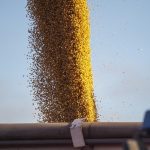
Harvest ahead of five-year average, topsoil moisture continues to deteriorate

Saskatchewan Crop Report for the week ending August 20

Another week of warm and dry weather has allowed producers to make great strides in the field, according to Saskatchewan Agriculture’s weekly Crop Report. Sixteen per cent of the 2018 crop is now in the bin, up from five per cent last week and significantly ahead of the five-year (2013-2017) average of seven per cent […] Read more


Drought conditions in Canada at June 30, 2018. (Agr.gc.ca)

Drought’s effects linger on Prairies

CNS Canada — After a dry growing season last year in Western Canada, effects of the drought are still evident with news that most livestock producers won’t be doing a second cut of hay. “Pastures and hay fields didn’t get the moisture that they needed to really recharge over that winter period and get a […] Read more

(Photo courtesy Canada Beef Inc.)

Prairie hay crops look thin in many areas

CNS Canada — Many farmers taking off their first hay cuts are also gathering more talking points to grumble over at coffee row. While many producers are still working to get the first cut done and the situation could change with the second cut, many regions are already reporting below-average yields. “In areas of the […] Read more


Krone Comprima round balers offer a variety of both fixed and variable bale chamber sizes.

New “Comprima” balers from Krone

The brand offers a new round baler series with a brand new look

This spring Krone introduced its new line of “Comprima” round balers that offer a variety of both fixed, variable and semi-variable bale chamber sizes. The brand is describing them as “new look” machines. The Comprimas use the company’s NovoGrip belt and slat system, which Krone claims helps produce a denser bale in both dry hay […] Read more

Deere’s new A520R Plus2 Accumulator carries up to two round bales 
behind the baler while the third is made in the chamber. The accumulators 
are compatible with 6, 7, 8, 9 and 0 Series round balers.

New forage equipment from John Deere

The Green Brand offers forage growers new balers and handling equipment

In 2015 John Deere introduced its first large square balers built entirely in-house, the L300 Series. For 2018 those balers get an update, and two new models, the L331, which makes a 3′ x 3′ bale, and the L341, which builds a 3′ x 4′ bale, will take their place in the Deere haying equipment […] Read more


Grass tetany isn’t a huge problem, but where or when conditions develop, it can be corrected.

Nip risk of grass tetany in the bud

Provide a tablespoon or two daily of magnesium mineral supplement before turnout

Every spring, I think about the possibilities of grass tetany in the cow herds going out to graze in on lush prairie grass. While nobody wants to find a fresh cow that died under mysterious circumstances, there is no need to panic. Fortunately, most threats of fatal grass tetany can be reduced by providing beef […] Read more

After a bit of trial and error we discovered a simple and inexpensive way to modify these feeders to prevent the heifers from climbing in.

Modify bale feeders for yearlings

Simple, relatively low-cost solutions to keep young stock out of the feeders

We have used large rectangular and round hay bale feeders for several years to feed replacement heifers and bull calves We prefer the flex feeders because they will accommodate a large rectangular bale or round bale, and, if not allowed to freeze to the ground, permit the calves to push and collapse the feeders to […] Read more


Getting faraway dry cows prepared

Getting faraway dry cows prepared

Ration should be about 80 per cent of the lactation nutrient package

As a dairy nutritionist I’ve noticed a new trend among dairy farmers in the last few years in feeding and management of their dry cows. The line between a faraway dry cow and close-up dry cow has faded and producers are feeding much more nutrient-packed rations to them than we used to. I am not […] Read more

It takes more than water and sunshine to grow grass — you need to
also plan for it.

Where does grass come from?

Aside from the obvious answer, it is important to have a grazing plan

We do some apparently strange things on our operation. We are short on cropland and long on native rangeland in our resource mix, so we run smaller cows and calve later than many of our neighbours. We also try to extend our grazing season, particularly the grass component, for as long as is humanly or […] Read more