

Equipment manufacturers are being affected in two main ways by the trade disputes that disrupted global trade in the past year.
The disputes have lowered farm incomes in North America — reducing the ability of farmers to buy new equipment — while having also increased manufacturing costs, making equipment more expensive.
WHY IT MATTERS: Aggressive U.S. government economic actions in 2025 reduced corporate profits across the agricultural equipment sector.
The imposition of countervailing tariffs on U.S. soybean sales caused a major income loss for U.S. farmers. Chinese tariffs on Canadian canola depressed some farm incomes here. Agricultural Manufacturers of Canada, which represents Canadian ag equipment manufacturers, estimates the sector saw a 30 per cent sales decline over 2025 as a result.
Read Also

Mahindra moving forward with new tractors, post-split
Despite the dissolution of a key joint venture, farm tractor manufacturer Mahindra Ag says a new product lineup will be rolling out over 2026 and 2027.
The Association of Equipment Manufacturers (AEM), which tracks tractor and combine sales, shows sales were down in both the U.S. and Canada.
In two-wheel drive tractors above 100 horsepower, the U.S. saw a dramatic overall sales decline of 22.6 per cent for the year. Four-wheel drive tractor sales declined 41.6 per cent and combine sales fell 35.6 per cent.
The picture in Canada was a little brighter, but still showed softer tractor sales. Hundred-plus-horsepower tractor purchases fell 12.1 per cent; four-wheel drives, 23 per cent. But combine sales grew about three per cent.
All of this happened as the farm equipment industry was already near the bottom of a demand cycle, with sales already slow going into 2025.
With Chinese tariffs on canola slated to return to more normal levels, Canadian farm income is likely to improve in 2026 — assuming weather events aren’t a factor.
In the U.S., the government has promised a second bailout to mitigate reduced incomes from trade disruption caused by the Trump administration, so there is some optimism for improving sales conditions in 2026.
But as U.S. President Donald Trump’s administration maintains an aggressive posture toward imposing sanctions and tariffs on an apparent whim, as well as threatening military action toward historic allies, it’s anyone’s guess how the GDP of western nations will be affected. Farm incomes will be caught in that web.
Bottom lines
It is clear, however, that ag machinery brands will continue to face reduced margins in 2026. John Deere, for example, estimated mid-year in 2025 that tariff costs would add US$600 million to its costs for that fiscal year. It expects that problem to continue into 2026.
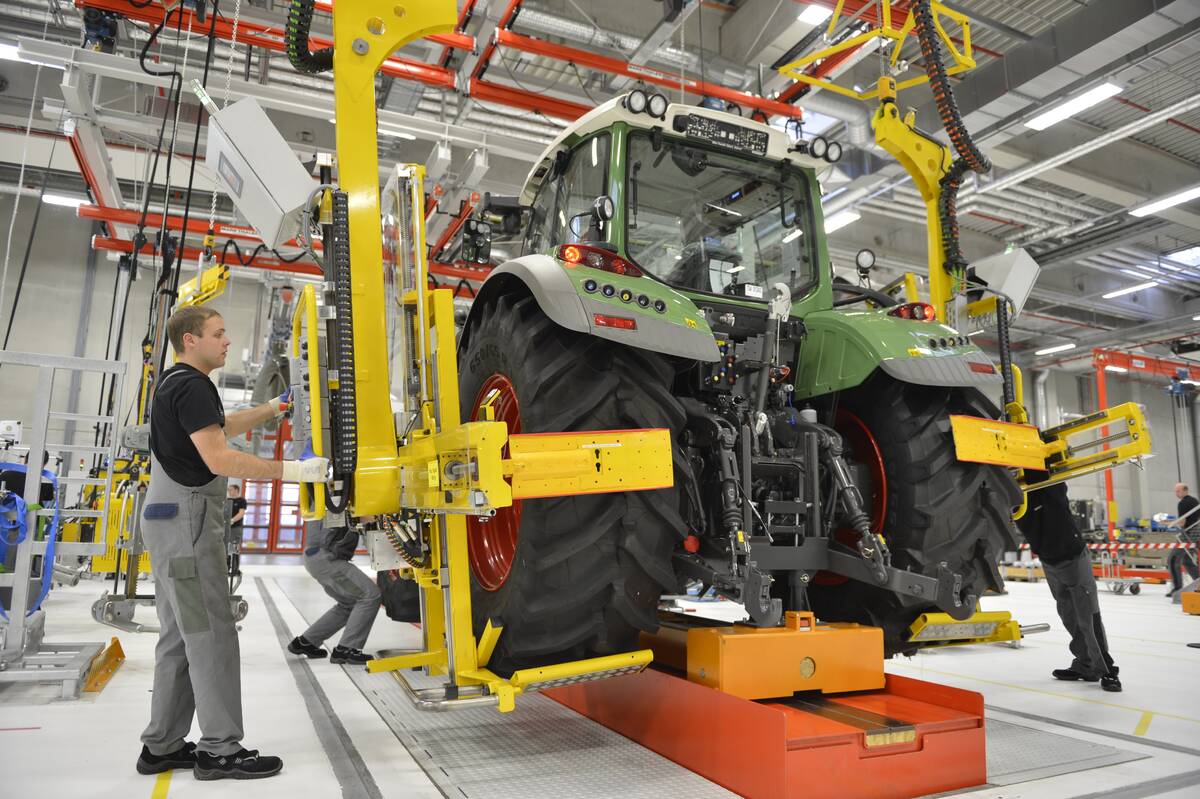
Much of Agco’s product line is built outside of North America and imported, making those machines subject to significantly higher tariff rates than machines built in the U.S.
Agco CEO Eric Hansotia said earlier in 2025 that the company would try to reduce the effect on imported equipment sticker prices by averaging tariff costs across its entire product line.
All brands in the machinery and automotive sectors are facing similar cost increases.
A statement by AEM said tariffs on steel and aluminum alone would impact U.S. manufacturing costs for brands by about seven per cent. That almost certainly means farmers will continue to face higher sticker prices on future machinery purchases.
Adding further uncertainty to equipment sales in 2026 is the upcoming renegotiation of the Canada-U.S.-Mexico Agreement (CUSMA).
During a visit to a Ford assembly plant in Michigan in January, Trump said of the CUSMA agreement, “There’s no real advantage to it. It’s irrelevant,” putting its future in jeopardy.
More recently he added: “If Canada makes a deal with China, it will immediately be hit with a 100 per cent Tariff against all Canadian goods and products coming into the USA.”
That would violate the existing CUSMA agreement.
Ignoring trade agreements, though, has become standard fare for the president. This past week, he said he would unilaterally change a trade agreement with South Korea, upping the tariff rate to 25 per cent, simply because the legislative process there hasn’t ratified the deal quickly enough to suit him.
All this means no agreement with the U.S. can be considered firm and binding as long as the current U.S. administration remains in power. It will only remain in force until the president decides it isn’t.
The U.S. is now arguably the least reliable trading partner on the globe. That means how ag equipment sales will shake out this year is far from certain. Under the current U.S. administration, manufacturers’ costs and market access going forward are completely unpredictable.