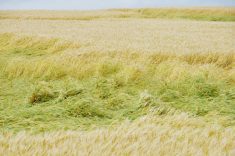
We all know too well what hailstorms and accompanying lightning do to our Prairie cropland from May until October. Heavy hailstorms can and will wipe out healthy crops completely, especially in mid- to late summer. Grain, pulse and canola crops can be total wipeouts. Despite their destructive nature, they have an upside as well as the expected downside.
A few years back I checked on a number of canola and grain fields north of Edmonton that had been heavily hailed in late June. All the fields, encompassing several thousand acres, looked like chopped vegetable salads. The owners talked wipeouts for the season but I advised them to wait a few weeks. Well, by late July all the fields were growing well and healthy in a good-moisture year, but obviously a month behind in crop maturity. At the end of a rainy summer and a long frost-free fall, all of the growers in the hailed area took off crops close to their target yields.
Read Also

Sask., Alta. farmers get strychnine against gophers until late 2027
Farmers in Saskatchewan and Alberta are cleared to use strychnine this year and next year against gophers wrecking their fields and pastures.
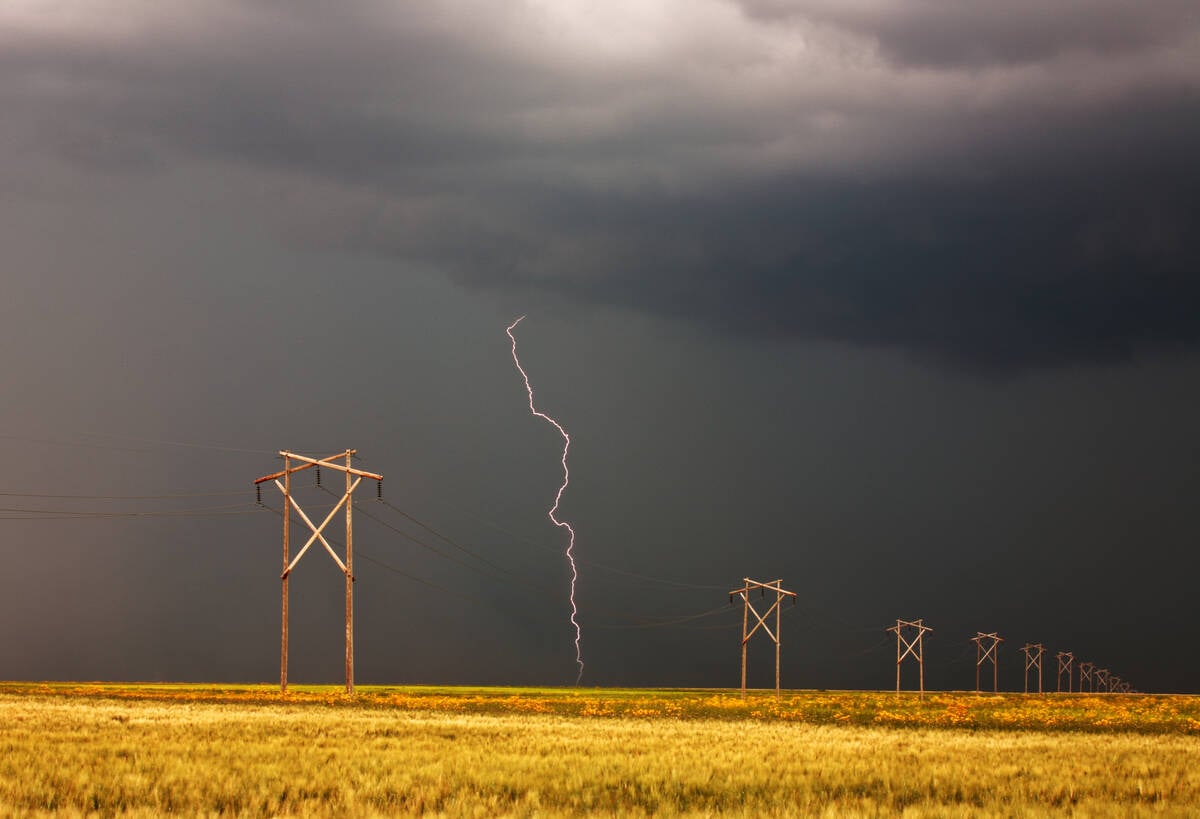
Thunderstorms with heavy rain and little or no hail can, depending on intensity, produce as much as five to 10 lb. of nitrate per acre from the reactive nitrogen dioxide produced by the lightning. Such storms contribute as much as one seventh of the planet’s fixed nitrogen fertilizer.
When you observe a thunderstorm, you’ll see the lightning bolts of the storm repeatedly strike into the ground, unless of course there is some high-ground tower nearby. Have you ever wondered what that lightning bolt did when it hit the Earth?
My first test came in Ontario in 1972 when I was checking out a rutabaga crop that was partially infested on a lower part of the field with clubroot. For your information, a rutabaga is just a winter annual Argentine canola. I found there was 100 per cent infection of the rutabagas in this lower part — but there was one healthy rutabaga, plumb in the middle of this group. I dug up this rutabaga and replanted it in a University of Guelph greenhouse, thinking that I had discovered a new kind of resistance, only to find there were already clubroot-resistant rutabagas readily available but customers did not like the varieties. They preferred the very clubroot-susceptible Laurentian rutabaga.
The grower then took me to other parts of the hilly rutabaga field and pointed out several dead, damaged areas of rutabagas. These damaged rutabagas were in roughly circular patches 10 to 15 feet in diameter. The rutabagas were dead and wilted in the middle of the circles, but healthy on the outer edges. I guessed and said “lightning bolts” – the grower smiled and said yes. He said he’d seen these spots on his lightning-prone cropland for years before he figured out the answer. He complimented me on my guess.
Subsequently, in travelling around Prairie cropland in Western Canada over the years, I pointed out many times that these diseased “spots” in canola, potato and cereal croplands were lightning strikes, to the relative amazement of many farmers. I even diagnosed a “diseased” farm vegetable garden in the Peace region that was indeed a lightning strike.
Bolted down
Unfortunately, lightning strikes can be far more destructive when peat and forest land are involved. I remember talking to Canadian forestry researchers at Edmonton in 1986 about lightning damage The personnel showed one aerial photograph of forest stands in Alberta’s foothills with brown/bleached specks dotted here and there. Again, I guessed lightning damage, as a good guess, and they were very surprised. It had taken them a few years to arrive at lightning bolts as the cause.
The lightning strikes during rainstorms, which killed off groups of trees, did not result in forest fires. Now, with drier weather conditions in recent years, these lightning strikes have frequently started forest fires. The persistence of up to 60 or more of these forest fires in Alberta, for example, is due to dry or fairly dry peat bogs. The irony is that we have people who oppose peat harvesting for horticultural soil mixes without the thought that these drying bogs become major fire hazards during dry windy summers. Peat bog fires can last for years. Vast areas of Russia’s Siberian forests have been severely damaged by fires, due to fire control failures and indiscriminate peat harvesting and drainage projects.
Trouble in the trees
Another aspect of lightning damage is the surprising number of tree “kills.” When you notice in particular very large spruce trees, especially around the more southern Prairie farmsteads, you often see one or more dead spruce trees in the farm shelterbelt or individual dead specimens. It could be disease, or perhaps prolonged spring flooding, but a very common cause is lightning.
Over the years I have been asked to look at specimens of dead spruce trees, both white and Colorado spruce, in cities and rural areas. Many times, I have diagnosed lightning strikes as the cause. How do I know? When lightning hits a spruce tree in, let’s say, August, nothing is obvious. Unfortunately, by May or June the following year, the tree is obviously dead. If indeed lightning was the cause then the lower four to five feet, if not trimmed, will still be green. If the spruce tree is close to a house, the spruce can be healthy green up to the house eaves. Lightning will jump the last few feet into the house or ground. In a shelterbelt, lightning may kill one to perhaps four or five adjacent trees.
Remember, lightning strikes are very common on the Prairies, so when you see these odd dead patches of cropland or suddenly dead spruce trees, think of those summer storms. If lightning hits a cottonwood or pine tree it usually causes the upper branches to split severely, damaging the tree, which may not be killed, as with a spruce tree.
On the old fable that lightning never strikes twice in the same place, I have proof that it can and does. The Leduc Rugby Club (near Edmonton) has had to replace one of its 40-foot (13-metre) goal posts twice in two years, due to them being shattered by lightning strikes at the exact same spot.