


Enhanced efficiency fertilizers have been available to growers for a number of years now, but are farmers rushing to use them in their fields?
The idea behind enhanced efficiency fertilizers (EEFs) is to maximize how much nutrient gets to the plant rather than being lost to the surrounding environment. The products control a slower release of nitrogen into the soil so they are more effectively taken up by plants.
It’s touted as a win-win for both farmers — lost nutrient means lost dollars, after all — and the environment, since a bigger percentage of nitrogen taken up by the plant means a lower percentage at risk of hitting the atmosphere as the greenhouse gas nitrous oxide.
Read Also
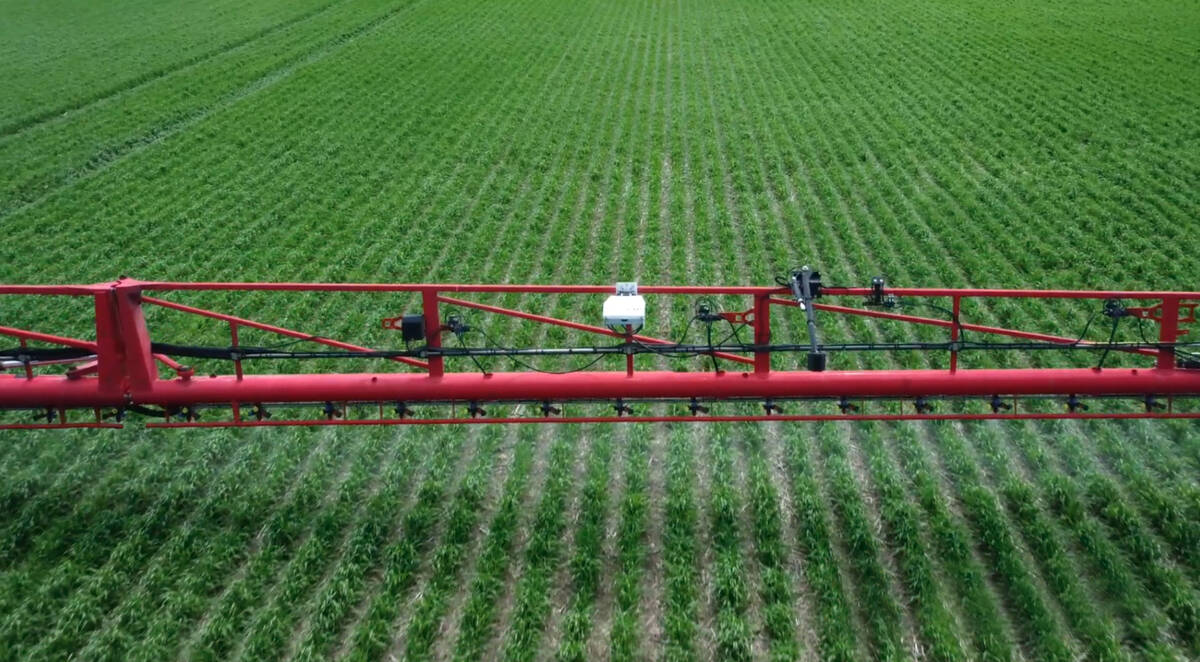
Croptimistic’s SWAT Cam maps one million acres in Western Canada
Croptimistic’s SWAT Cam has mapped more than one million acres, using sprayer-mounted cameras to generate crop and weed maps that support in-season analysis and future management decisions.
“Farmers need to think about, and agronomists need to think about, ‘why am I using this?’” said Lyle Cowell, a senior agronomist with Nutrien Wholesale.
“From the farmers’ perspective, there always has to be, ‘What’s in it for me?’ And the primary answer to that is fertilizers cost farmers money, and we don’t want to lose fertilizer for an economical reason. One, you bought that fertilizer, you don’t want to lose the fertilizer. Plus, if you lose fertilizer from your farming system, that can mean you have a low yield.”
Cowell also pointed to the environmental reasoning behind the products.
“Nitrogen can end up in the wrong place, as nitrates in ground water, as gaseous products in the air, as nitrous oxides and ammonia, and off-farm, we need to be conscious that the fertilizers we use don’t harm people or the environment as well,” he said.
On the downside, EEFs can be more expensive than conventional fertilizers, and inviting farmers to move away from practices that have worked for them for years can be a hurdle.
As for what the future holds for EEFs, “time will tell,” added Cowell.
The products have commonly showed up in crop research plots as academics and industry try to home in on their best use.
“We’re often using EEFs in a broad sweep across the whole farm or the whole field, and perhaps they don’t need to be,” he noted. “Maybe they need to be used as a variable rate product as well applying them in the farm or in the field where they’re most effective.”
Fall fertilizer advice
How well harvest season goes often determines how much fall fertilizer actually makes it into the field.
Doing it right protects a grower’s investment of time and money from nitrogen losses due to volatilization, leaching or denitrification.
If you opt to broadcast fertilizer in the fall, a dual inhibitor is the way to go, says Bryce Geisel, senior agronomist with Koch Agronomic Services.
SuperU is one such option.
“It has both the urease inhibitor and denitrification,” said Geisel, “so we reduce all three forms of loss. So that’s a big step with those dual inhibitors with it.”
Fall anhydrous ammonia applications are common in Manitoba, he noted. In those cases, a nitrification inhibitor may be of benefit.
“Typically, what farmers have done in the past is they’ll wait until the soil cools down, and then they put that anhydrous ammonia in,” said Geisel.
“Fall is getting very compact. There’s a lot of operations that are happening. So one of the trends we are seeing is farmers and agronomists looking for nitrification inhibitors.”
As far as uptake among farmers for EEFs is concerned, it really depends on the individual farm.
“Obviously, there’s the environmental piece that people have talked about,” said Geisel, “but there’s also what we tend to see is a lot more (focus) on the operational efficiency piece where farmers are using it to spread out their fertilizer applications.”
“There’s a lot of different ways farmers are playing with it to help manage costs.… They’re picking and choosing what kind of fits in their operation.”