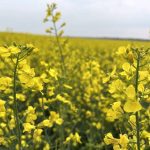
This field of canola treated with the biological product Utrisha N was part of the Corteva Agriscience trials in 2021. During an extremely dry growing season across most of Western Canada last year, Corteva trials showed there was on average a 1.3-bushel-per-acre yield advantage for canola growers who applied Utrisha N, delivering a positive yield response 69 per cent of the time. It’s not a huge yield increase, but with canola in the $20-plus-per-bushel range, it more than covered the cost of the product. What can the product do under improved growing conditions?

Can biological crop inputs for cereals and oilseeds work?

Foliar-applied nitrogen-fixing biologicals for grains and oilseeds are a great concept. Here, four Prairie farmers share their experiences

There aren’t too many western Canadian farmers who would consider growing a pulse crop without first applying rhizobium bacteria to the seed to help the plant roots fix nitrogen in the soil. The benefits of that technology are well proven and accepted. But what about a foliar application of bacteria to the leaves and stems […] Read more


Tim Nerbas of NRG Farms in northwest Saskatchewan, says he usually does a bit of both pre- and post-harvest
treatments on about 4,000 acres of crops, which include wheat, oats, barley, canola, flax and faba beans.

The best fit for pre- or post-harvest treatments

With erratic growing season conditions producers need to be flexible with fall weed control plans

Farmers Owen Orsak and Tim Nerbas hadn’t got the 2022 crop in the ground yet when they were asked in early May about their fall weed control plans, but the Manitoba and Saskatchewan producers, respectively, say they will apply desiccation and weed control measures on their farms this year depending on weed growth and harvest […] Read more


File photo of a pea crop south of Ethelton, Sask. on Aug. 1, 2019. (Dave Bedard photo)

Pulse weekly outlook: Still early in season to switch crops

Decisions likely in next couple of weeks

MarketsFarm — With dry conditions dominating western and southwestern Saskatchewan and wet conditions prominent in the province’s east and northeast, at mid-May it remained early to consider switching pulse crops to something else, according to Carl Potts, executive director of Saskatchewan Pulse Growers. Overall, he said, spring planting throughout the province as of May 9 […] Read more


Red spring wheat. (File photo)

Mildew scrapped as grading factor for No. 3 wheats

Grading changes also planned for canola admixture, splits in peas, excreta in mustard

The Canadian Grain Commission will change its standard samples for mildew in No. 1 and No. 2 wheats, and drop it as a grading factor for No. 3 wheats, effective this summer. The CGC on Monday laid out a list of changes to its grain grading policies and standards for wheat, canola, peas, beans and […] Read more

File photo of flooded cropland in the RM of St. Andrews, north of Winnipeg. (Manitoba Co-operator photo)

Pulse weekly outlook: Wet weather delays southern Manitoba seeding

Soybeans could take yield hit if planted in June

MarketsFarm — Another blast of heavy precipitation across southern Manitoba, the third in as many weeks, has already delayed seeding for pulses, according to a production specialist. Laura Schmidt, a production specialist for Manitoba Pulse and Soybean Growers, said the 40 to 50 millimetres of rain across the region on April 29-30 all but guaranteed […] Read more