


U.S. Ambassador Pete Hoekstra says Canada should make the case that it’s a good business partner so it can avoid high tariffs. Some Canadian agriculture experts say that’s already happening.
WHY IT MATTERS: Conversations between Canadian and American agriculture groups could help set a tone ahead of the CUSMA review this summer.
Read Also

ICE Canada Weekly: More behind canola, soyoil than crude oil prices
There’s more to canola futures on the Intercontinental Exchange than crude oil and vegetable oils prices, said David Derwin, commodity futures advisor for Ventum Financial in Winnipeg.
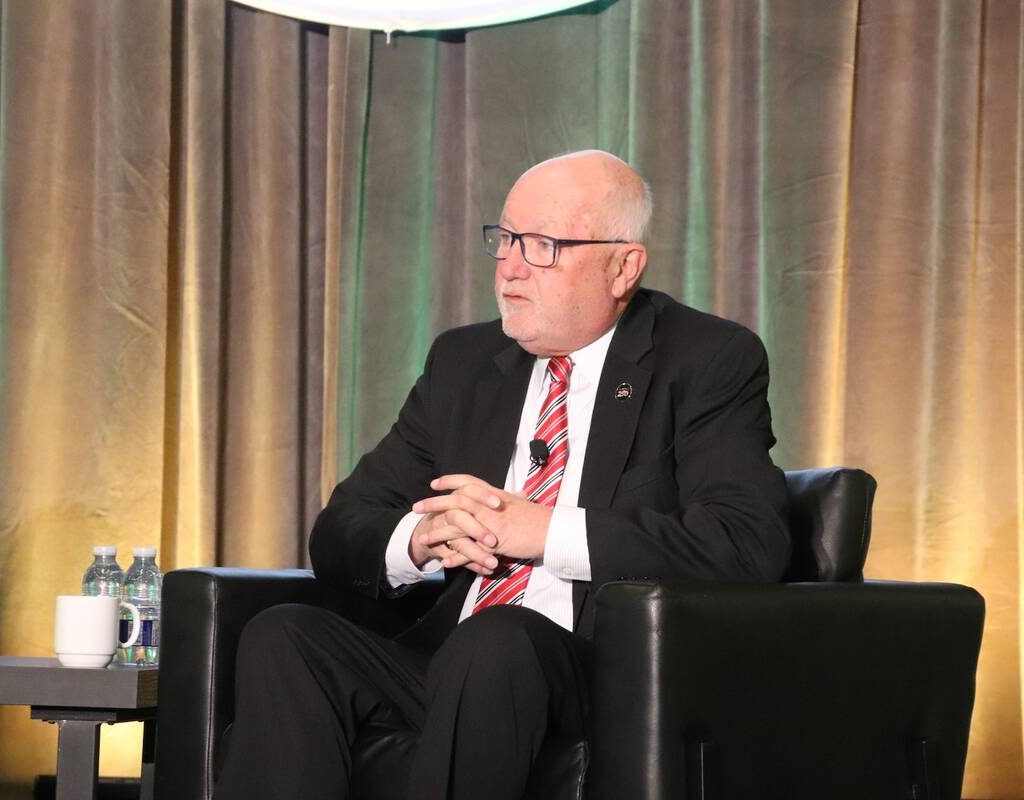
Hoekstra spoke at the Canadian Crops Convention in Toronto on March 12.
He said tariffs are likely to stay on as cost of doing business in the American market. Canada should “do everything they can to get into the lowest tariff buckets.”
“You can make compelling cases for us to do business with Canada and Canada to get the lowest tariffs of any trading partner in the world,” Hoekstra said.
U.S. and Canadian businesses both need to advocate for that relationship.
Cross-border relationships
Some in the Canadian agriculture sector say that advocacy is already underway.
Michael Harvey, executive director of the Canadian Agri-Food Trade Alliance said many Canadians have been advocating for cross-border business relationships. Last fall, CAFTA led a trade mission to Washington D.C. involving 12 national industry groups. The group’s goal was to highlight the importance of renewing the Canada-U.S. Mexico Agreement.
Pierre Petelle, CEO of CropLife Canada, said he has seen U.S. farm groups openly support CUSMA over the last six months — something not common in the early days of the second Trump presidency.
“That puts us in a much, much better position,” he said.
Canada shouldn’t overestimate its value: Hoekstra
When negotiating trade, Hoekstra said Canada must not overestimate its value to the American market.
“We don’t wake up in the morning worried about Canada,” he said. “You don’t find Americans advocating … ‘boycott Canadian products.”
“When you walk into the negotiating team, or you get on TV and you say, ‘America needs our fill-in-the-blank,’ whatever commodity you’re talking about, you’re going to get a certain kind of response,” Hoekstra said.
“Because for just about everything that you bring in, it’s kind of like, ‘no, we really don’t.’”
The U.S. has done a good job of diversifying its markets and cultivating long-term relationships said Darcy Pawlik, executive director of the Wheat Growers Association. This gives some truth to the idea it doesn’t need Canadian imports.
“They’ve done the diversification of their procurement already,” Pawlik said. “Canada, we have really not carried the ball in a mature way, from a trade perspective internationally, from diversifying markets.”
Canada may have some commodities American need, but Pawlik said in many cases it has found other options.
‘We should always aim for free trade’
Hoekstra suggested pitching why doing business with Canada is a “phenomenal deal” for the United States.
“You will get a much different response in Washington than coming in and saying, ‘you absolutely need our stuff.’”
A compelling case could land Canada in the lowest tariff bucket, the ambassador said.
Being in the lowest bucket shouldn’t be Canada’s goal, Pawlik said.
“We need to always aim for zero-tariff,” he said. “We should always aim for free trade.”
“If there’s some points of negotiation that the Canadian government just can’t find a way to work together on and we end up in that lowest tariff bucket, then so be it. But we should never start from a place of being OK with some tariffs. We’ve got to aim for zero.”
Integration of supply chains a key bargaining point
Entering negotiations with a “we have what you need” approach could indeed be harmful, as it will only upset Trump and his administration said Patrick Leblond, a professor at the University of Ottawa’s Graduate School of Public and International Affairs, in an email to Glacier FarmMedia.
However, the U.S. is not entirely self-sufficient.
“Yes, Canada has some of what the U.S. needs, but we’re not the only ones,” Leblond wrote, adding the U.S. has more leverage than Canada on this issue.
Petelle said it may be important to consider the integration of Canada-U.S. supply chains as opposed to what goods one country needs over the other.
Whether crop protection products and seed, or processing and feed, the supply chain is “extremely integrated,” he said.
In the seed and crop protection sector, Canada probably needs the U.S. more than it needs Canada, Petelle said.
“We import a lot of our seed directly from the U.S. and other regions. A lot of the manufacturing of crop protection is done in the U.S. … so we’re pretty reliant on the input side for seed and crop protection.”
Canada and the U.S. “really produce food together,” Harvey said citing examples of beef crossing the border to be processed and Canadian wheat going to an American plant before being sent back to Canada.
“We’ve really got this deeply integrated production model, and it would be very negative for American interests for that model to be … gummed up,” he said.
American agri-food sector on board with CUSMA
“I think the most important thing is to have American interests who are in favor of the relationship,” Harvey said, “we’re seeing it really clearly that the American agri-food sector is in favor of continuing the treaty.”
In February, 40 American agricultural organizations formed a coalition to support CUSMA. Nearly 100 Canadian groups made a similar plea in December.
Petelle said this alignment between American and Canadian groups is a positive signal and could mean the beginnings of good negotiations between the two countries.
Despite his assertion there will always be a cost of entry in the American market, Hoekstra said the U.S. is interested in renewing CUSMA.
Pawlik said Canadian commodity groups should start talking with their U.S. counterparts ahead of the CUSMA review this summer.
“Wheat organizations talk to the wheat organizations, you know, and soybeans talk to soybeans… so that when they get to the negotiating floor, they can say, ‘hey, no problem. We’ve actually got industry leading these conversations. We’re figuring out ways to get along.’”
‘Get back to the table’
Hoekstra said negotiations around the trade agreement have been stalled by headwinds from Canada. He said there “hasn’t been a substantive discussion since the end of October” between the two countries.
Petelle said he saw things differently.
“It was interesting to hear the ambassador characterize it as ‘four months lost,’” he said. “Last time I checked, it was the U.S. that broke off the discussions.”
“We’ve had several months of nothing really moving, but I think that decision was theirs last fall,” he continued. “So, the first thing is to get back to the table and start having serious conversations, rather than through the media or through public statements by ambassadors and others.”
Pawlik said many Canadians would do well to have a better understanding of CUSMA and how tightly connected the two countries really are.
“The one thing that we continue to forget is that we are allies, right?” he said. “(We should) treat each other with maybe a little bit more respect than what we’ve been seeing to date, and that should be encouraged amongst all Canadians.”