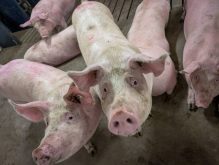
Chicago | Reuters — Chicago Mercantile Exchange (CME) lean hog futures fell Monday on worries that deteriorating relations between the United States and China, the world’s biggest pork importer, could inhibit U.S. pork sales to the Asian nation, traders said.
China told state-owned firms to halt purchases of soybeans and pork from the United States, two people familiar with the matter said, after Washington said it would eliminate special treatment for Hong Kong following China’s move to tighten security measures in the territory.
Such a halt would put China further behind in making good on its pledges under the “Phase One” U.S.-China trade pact signed in January.
Read Also
Klassen: Negative margins weigh on Western feeder cattle market
For the week ending April 4, Western Canadian feeder cattle prices were quite variable. Backgrounded replacements were relatively unchanged, however…
“China has already been backing off from pork purchases over the past three weeks,” said Rich Nelson, chief strategist for Allendale Inc.
Weekly U.S. pork sales to China averaged more than 23,000 tonnes from early March through April, but net sales through the first three weeks of May were a net negative 417 tonnes, according to U.S. Department of Agriculture data.
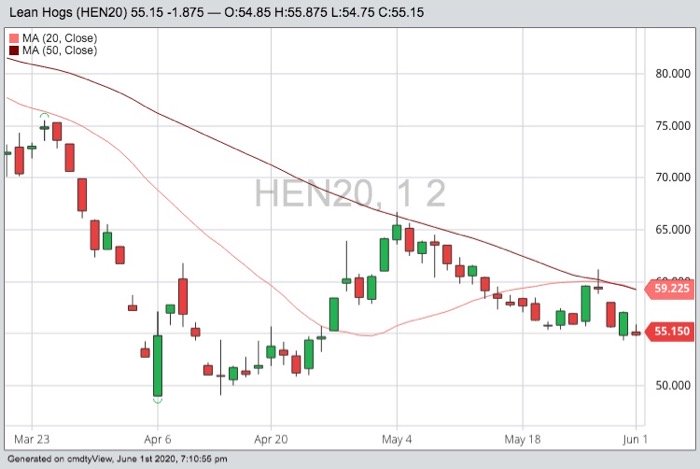
CME June lean hogs ended down 2.25 cents at 54.6 cents/lb. on Monday, while most-active July futures settled down 1.875 cents at 55.15 cents/lb. (all figures US$).
Wholesale pork prices fell. USDA reported the U.S. pork cutout, an indicator of wholesale prices, down $4.87 at $83.33/cwt at midday. USDA’s afternoon update stretched the decline to $7.16, at $81.04/cwt.
The U.S. daily slaughter pace has been improving since April, when coronavirus outbreaks among workers forced numerous pork and beef packing plants to close. But a backlog of market-ready hogs persists, a factor that hangs over the futures market. A full recovery “could be a ways off,” Nelson said.
CME live cattle futures closed lower, despite cattle trading in the cash market at a significant premium to nearby futures.
Market-ready cattle traded on Monday at about $118 per hundredweight in the southern Plains, USDA confirmed, a price the government termed “unevenly steady” with the bulk of last week’s trade, while CME June live cattle settled on Monday at 98.3 cents/lb., down 1.425 cents for the day.
Most-active August live cattle futures ended down 0.625 cent, at 98.975 cents/lb.
CME feeder cattle futures bucked the weak trend, with benchmark August finishing 0.775 cent higher at 136.125 cents/lb.
— Julie Ingwersen is a Reuters commodities correspondent in Chicago.