
Reuters — U.S. President Donald Trump’s use of tariffs as a foreign policy tool added fresh impetus in Davos, Switzerland, this week to efforts to boost global trade beyond the United States, with frustration palpable among many of Washington’s top trading partners.
Why it matters: Canada relies heavily on trade with the U.S., and has been working at diversifying its trading partners.
Tariffs roared back into focus when Trump last weekend threatened new tariffs on European allies opposing his designs on Greenland, before stepping back from them on Wednesday after announcing a deal framework with NATO over the Arctic island.
Read Also
Shares slump, bonds skid as oil surge threatens inflation shock
Wall Street opened lower Monday as the inflationary jolt from surging oil prices threatened to raise living costs and interest rates around the globe, while investors desperate for liquidity fled to the U.S. dollar.
“It’s the speed, scale and scope of change that is really rattling the world,” Canadian Finance Minister François-Philippe Champagne said during a panel discussion on tariffs at the World Economic Forum’s annual meeting in the Swiss mountain resort.
The WEF is meeting in Davos for the first time since Trump last year hiked U.S. tariffs to their highest level in nearly a century, sending countries scrambling to pick up the slack by trading more with each other.
Trump, who says his policies are bringing back jobs to the U.S., spurring trillions of dollars in investment and firing up growth, is ever present in WEF debates over how to temper exposure to the U.S., which studies forecast will play a lesser role in overall global trade than it did in the past.
Canada’s Champagne said countries were diversifying their commercial relations and doing more at a regional level to make their economies more resilient to trade policy shocks.
“When you talk to CEOs today, what do they want? Stability, predictability and the rule of law. I would say it’s in short supply,” he said, days after Canada and China struck a deal to slash tariffs on electric vehicles and canola.
Hot on its heels came the signing of a free trade agreement this month between the European Union and South American bloc Mercosur after 25 years of negotiations — the EU’s largest ever trade pact, if it overcomes remaining legal obstacles.
Diversification of supply chains and reducing over-dependence are backed by the World Trade Organization, whose director-general Ngozi Okonjo-Iweala said such moves helped spread job creation and growth to other countries.
“This helps build global resilience and we are very supportive of it,” she told Reuters in Davos.
‘THE WORLD HAS BECOME MORE EXPENSIVE’
Boston Consulting Group forecasts the U.S. share of global goods trade could decline from 12 per cent to nine per cent in the decade through 2034, giving way to more domestic U.S. economic activity.
“Trump is sawing on the branch he’s sitting on,” Dirk Jandura, head of Germany’s BGA exporters’ association, said this week after data showed German exports to the U.S. falling by nine per cent during the first 11 months of 2025.
Volker Treier, foreign trade chief of the German Chambers of Industry and Commerce, said surveys showed tariffs on raw materials like steel and aluminium were making it dearer for companies to build up U.S. industrial capacity.
U.S. manufacturing activity contracted for a tenth month running in December, according to a closely watched survey.
“The world has become more expensive, and structurally it will get even more expensive,” Treier said.
‘WE HAVE TO RECONFIGURE OURSELVES VERY FAST’
BCG posits a patchwork of four main nodes dominating world trade: the U.S., China, BRICS+ minus China, and so-called plurilateralists comprising most of Europe, Canada, Mexico, Japan, Australia and several Asia-Pacific economies.
In the BCG study, trade among plurilateralists and China’s commerce with allies in the Global South would be key drivers of global trade, with U.S. trade advancing more slowly.
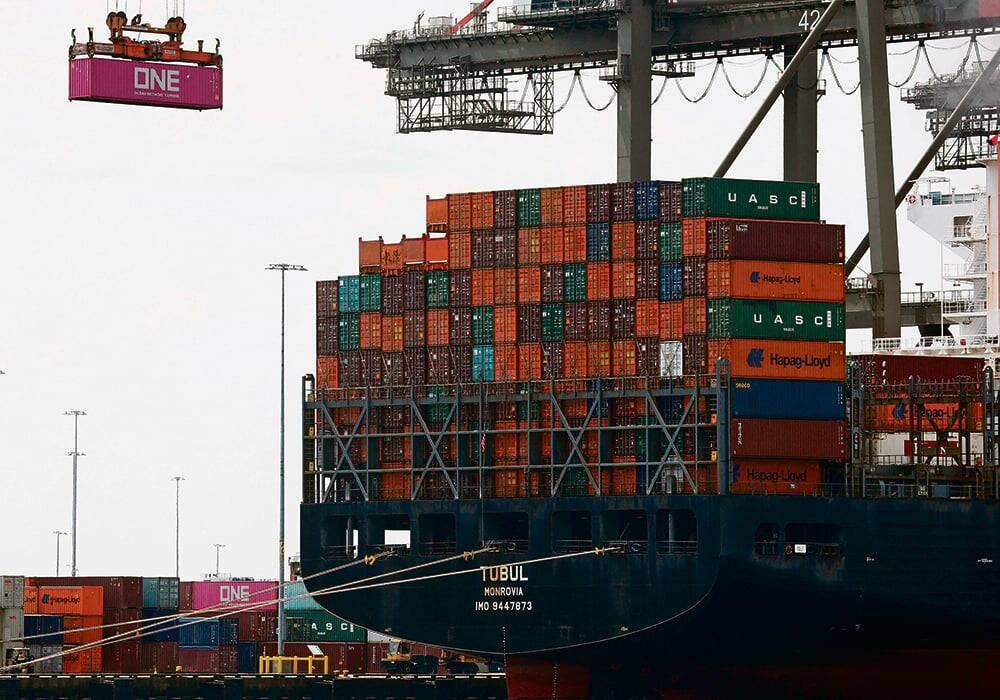
Noel Hacegaba, CEO of the Port of Long Beach, said trade flows have been evolving significantly since Trump’s first term.
In 2019, 70 per cent of the port’s cargo was trade with China; by last year, that figure had fallen to 60 per cent, with more coming instead from farther afield in Southeast Asia, including Vietnam, Thailand and Malaysia, Hacegaba told Reuters.
Boudewijn Siemons, CEO of the Port of Rotterdam, Europe’s biggest, said trade flows were adjusting rapidly to the new reality, and that the continent needed to be nimble.
“We’ve been relying on cheap production in China, cheap energy from Russia, and cheap defence from the United States,” he said, adding: “And all three of these securities are falling away, so we have to reconfigure ourselves very fast.”
— Reporting by Dave Graham and Mark John