
The Saskatchewan government has announced research funding and a new satellite forage insurance program.
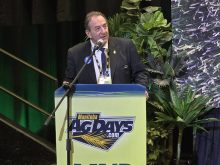
Agriculture minister David Marit, while speaking at the Saskatchewan Beef Industry Conference in Saskatoon Jan. 21., announced $4.5 million in livestock and forage research and renewed $3.9 million to the Prairie Swine Centre and the Vaccine and Infectious Disease Organization.
The $4.5 million in research is a joint federal-provinical investment between the Sustainable Canadian Agriculture Partnership and the Agriculture Development Fund. It will support 25 new projects, including research for ergot detection in feed and cattle biomarkers for Johne’s disease.
Read Also
A Prairie farmer’s praises of mechanical weed control, at Agritechnica
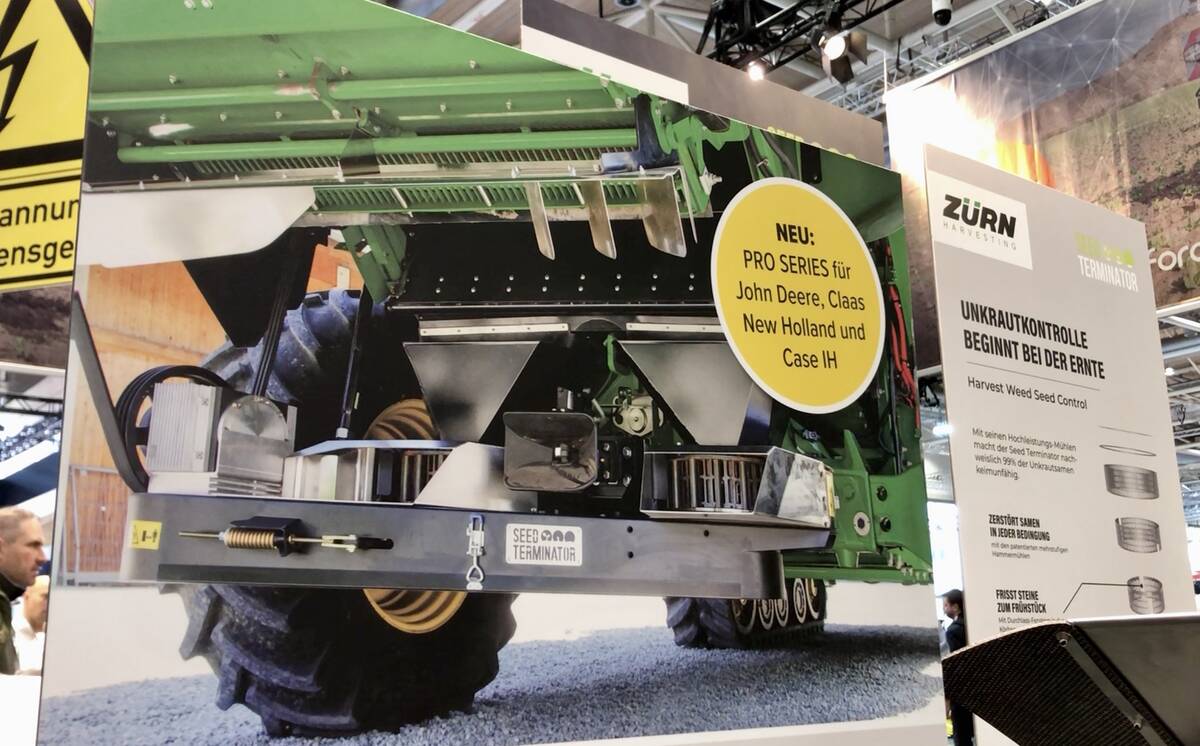
Saskatchewan farmer Josh Lade talks about his experience using the Seed Terminator on his farm and how the mechanical weed control device reduces herbicide costs.
In total, there will be:
- seven beef projects;
- one beef and dairy;
- five poultry;
- two sheep;
- two swine;
- one multiple species; and
- six forage.
The projects were chosen by the ADF advisory committee, comprising academia, industry officials and producers.
“It’s my understanding they’ll get two or three hundred different applications on research and go through them all and really evaluate what are important in Saskatchewan farms and ranchers,” said Marit.
“What I really like about it really removes it from the political side, and it really does address what the industry is really looking for and is wanting.”
Another $1.3 million was contributed by 13 industry partners:
- Alberta Beef Producers
- Alfalfa Seed Commission of Alberta
- Canadian Poultry Research Council
- Manitoba Forage Seed Association
- Results Driven Agricultural Research (Alberta)
- Saskatchewan Alfalfa Seed Producers Development Commission
- Saskatchewan Barley Development Commission
- Saskatchewan Cattle Association
- Saskatchewan Chicken Industry Development Fund
- Saskatchewan Forage Seed Development Commission
- Saskatchewan Pork Development Board
- Saskatchewan Sheep Development Board
- Western Dairy Research Collaboration
The funding to VIDO will help the organization communicate with producers and continue research projects such as bovine tuberculosis vaccine and cache valley disease.
For the swine centre, the focus will continue on animal nutrition, pathology and addressing diseases such as African swine fever and porcine epidemic diarrhea. It is currently working with the government to commercialize the PED rapid test kit it has developed.

Improvements to forage insurance
Marit also announced that the Saskatchewan Crop Insurance Corp.’s satellite forage insurance program will be available this year.
“Satellite forage insurance is replacing the forage rainfall insurance program,” he said.
“FRIP is no longer available, and all existing FRIP customers will be automatically enrolled into the satellite forage insurance program.”
Claims and premiums will be localized at the township level, and producer information packages will be available in mid to late February, including coverage options and premiums.
Establishment of the program follows the Saskatchewan Crop Insurance Corp.’s pilot that was conducted to assess its effectiveness. It provides greater, more accurate rainfall and soil moisture information for producers and crop insurance.
Jolen Shea, vice-chair of the Saskatchewan Cattle Association, was part of the pilot program at her ranch near Kindersley.
“I just found it to be a lot more accurate for what was actually happening on my ranch,” she said.
“The soil moisture measures on a kilometre by kilometre scale, so a rain event that actually happened on my ranch, as opposed to just at the weather station that’s about 20 km away.”
It includes an easy-to-use online portal to access the local data and was “very informative.” Shea said she would often go onto the portal the next day and see accurate, immediate soil moisture data.
The data also accounted for the highs and lows in weather, as well as for heavy wind that sucks out moisture.
“It seems like we’re moving in the right direction,” she said.
“So I really hope it takes away some of those issues and some of that variability that came with selecting weather stations and … playing the lottery game.”
Opening the Chinese market
Those attending the conference were also pleased with Canada and China’s recent trade agreement, including provisions to re-open China to Canadian beef.
JBS recently announced it will soon be sending its first shipment to China.
“I didn’t realize the number was that big … before China put the ban on,” Marit said.
“We were around $200 million worth of beef going into China.… To see that back open, it just gives our producers another market.”
He expects the beef market to increase in the same that the pea market responded following the reduction of pea tariffs — not dramatically but by small and steady amounts.
SCA chair Chad Ross agreed, saying this is “huge” for Saskatchewan and Canadian beef producers, especially with the added value that the Chinese market brings.
“Commonly they would use the offals and the lower end cuts that we don’t like to eat here in Saskatchewan and Canada,” he said.
“So that’s really good for us, but they also have an appetite for the high marbling tasty cuts as well. So there’s a little bit of both.”