

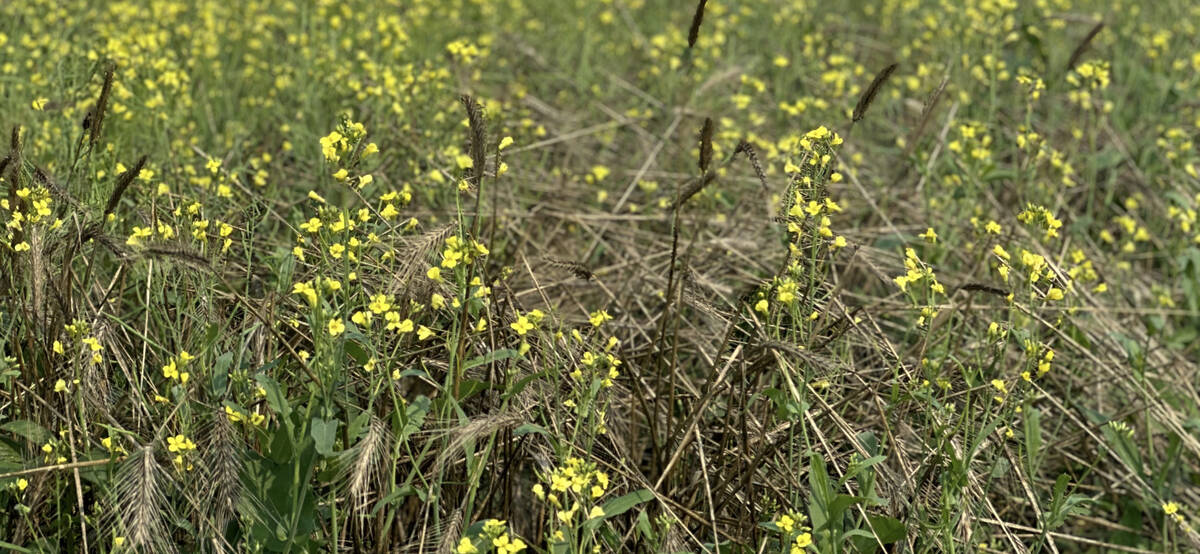
Researchers may have stumbled onto a surprising way to shield young canola plants from flea beetles: hide them behind a cover crop.
That simple idea sparked a four-year research project at the University of Manitoba, where Yvonne Lawley, associate professor of plant science, and Alejandro Costamagna, professor of entomology have been testing whether standing cover from fall rye or spring-seeded nurse crops can reduce early feeding.
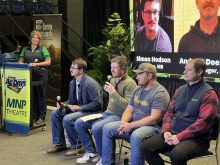
The work was demonstrated publicly at the U of M Field Day in Carman this past July, where Lawley and two graduate students presented the results and the agronomic questions arising from them.
Read Also
Croptimistic’s SWAT Cam maps one million acres in Western Canada
Croptimistic’s SWAT Cam has mapped more than one million acres, using sprayer-mounted cameras to generate crop and weed maps that support in-season analysis and future management decisions.
Why it matters: Flea beetles remain one of the Prairies’ most frustrating canola pests, and early feeding damage can push growers toward costly in-season sprays.
The concept started with a social media thread.
Several farmers had accidentally left fall rye standing too long in spring, then noticed their canola seedlings seemed to suffer less defoliation. Rather than brush off the anecdote, after a gentle nudge from her grad students, Lawley dipped her toe into the discussion, then quickly became immersed.
“Agronomists and farmers were sharing their collective observations in the social media space about this effect,” she said.
The outcome of those discussions led to a formal study with support from Manitoba Canola Growers and funding from CARP (Canola Agronomic Research Program). The goal was to test whether a living cover could shield canola long enough for seedlings to outgrow their most vulnerable stages.
Small-plot findings
Graduate student Aleksander Zashev walked farmers through four seasons of small-plot trials comparing fall rye termination timings. Late termination — holding off until canola reached the two-leaf stage — consistently led to less defoliation and fewer flea beetles. However, those same treatments also posed the highest risk of yield loss. In two of the four years, tall rye shaded the canola enough to drag yields down.
A clear pattern was emerging: more biomass meant more protection, but the added competition risked greater yield losses.
Spring-seeded oats were also evaluated as a nurse crop because they pose far less agronomic risk than fall rye. Oats emerge later and grow shorter, so they are far less likely to shade canola seedlings. The oat treatments produced little change in defoliation or flea beetle numbers, except in one case at a higher seeding rate. The results were predictable, but still useful: they reinforced the pattern seen with rye — biomass is the main driver of the hiding effect.
Lawley said the challenge is finding the sweet spot between maximum hiding and minimal shading. Waiting until canola reaches the two-leaf stage offers the strongest hiding effect, but that same biomass can shade seedlings and slow early growth.
Data showed the most balanced option was terminating when canola was still at the cotyledon stage. Because glyphosate doesn’t kill the rye immediately, the standing plants provide a short window of protection before they die off.
“We have a seven-day window before that fall rye is terminated,” said Lawley.
Taking it to the field
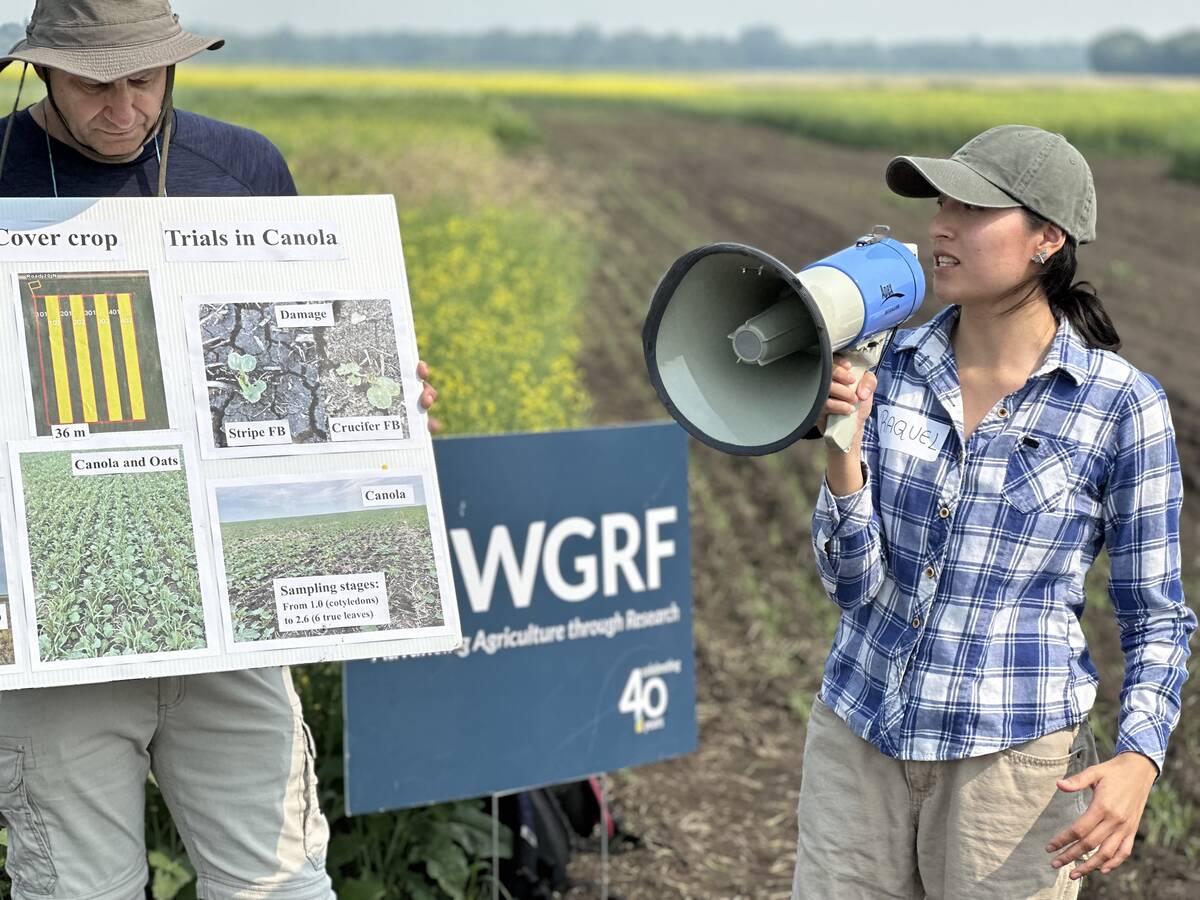
Graduate student Raquel Chinchin Talavera presented the on-farm phase of the study. That phase was launched in 2024 with four cooperating growers in the south-central region of the Red River Valley. Full-field strips, 36 metres wide, were seeded with and without a cover crop to see whether the small-plot trends hold under real farm conditions.
Early observations show slightly more flea beetles in bare canola strips than in strips with a living nurse crop, though the wider spacing between monitoring traps means overall counts are lower than in the small plots. Yield data from the second season is still pending.
While the research has validated that standing cover can interrupt flea beetle activity, Lawley wants growers to be cautious in how they interpret the early results. There are still many unknowns. Row orientation, stand density and fertility management could all influence outcomes. And, significantly, the agronomic costs (yield hits from competition, shading, moisture use and possible nitrogen tie-up) are real.
So, would Lawley recommend this for large acres at this point?
“No, we’re still working on it,” she said. “I feel like it’s still a high-risk practice for canola at this point.”

Where it could lead
Despite the uncertainty, she sees potential. Growers already experimenting with fall rye or spring nurse crops for soil health or weed management may one day be able to layer flea beetle suppression into those systems. But before any of this becomes a recommendation, researchers need to fine-tune the agronomy enough to reduce the risk of yield penalties.
The project concludes its CARP-funded phase after the 2025 season, but Lawley has already seeded more fall rye to continue teasing apart the variables. She hopes future work can answer questions about seeding rate, termination timing, nitrogen management and how to optimize cover without compromising stand establishment. The biggest unknown remains how the flea beetle feeding process is disrupted.
“We still don’t understand the mechanism of how flea beetles are seeing, smelling, sensing the canola, and how having living cover interrupts it,” she said. “It would be worthwhile trying to understand that mechanism so we can optimize this practice.”
For now, the idea remains a promising possibility rather than a new tool — a reminder that Prairie innovation often starts with a farmer noticing something odd, and a curious researcher willing to follow the thread.
“We’ve validated the observation that cover crops can hide canola from flea beetles. Now we need to de-risk it.”