
Whenever parts of the Prairies get excess moisture, you can expect there to be crop lodging.
It’s always blamed on excessive nitrogen causing excessive growth. Many growers in such wet seasons try various growth regulators, often with little or no effect, hoping to prevent crop lodging.
Let’s get to the real reason why wheat lodges in wet or rainy seasons.
Read Also

War hits farm equipment makers’ share prices
There could be a very rocky road ahead for the U.S. economy, and valuations of U.S.-based corporations, such as major equipment makers, could continue to take a beating, Scott Garvey writes.
Soils most prone to wheat lodging in wet seasons are:
- sandy,
- sandy/loam,
- sandy/high organic matter,
- heavy in cattle manure applications, and/or
- silt soils along old river courses.
What do these soils have in common? They’re usually very low in available copper in the top six to eight inches, often of the order of 0.2 to 0.5 parts per million (ppm).
Testing, treating for soil copper
Potato growers favour sandy, silty soils. They’re the best soil types for clean, mud-free potato production.
What do potato growers do when they rent such sandy fields from neighbouring grain growers? They perform extensive soil tests — not only for macronutrients, but for micronutrients as well. They may add several pounds of manganese, zinc, copper and boron if necessary per acre. If copper levels are low (below one ppm) in sandy soils, potato growers will add three pounds of copper (12 pounds of bluestone) per acre to bring the copper level up to two ppm.
What happens when farmers plant a wheat crop following potatoes in the rotation? They usually brag about the big jump in wheat yield. They ascribe the yield increase to leftover nitrogen or phosphate from the potato crop. I do not agree.
I live in an area of many potato growers and lots of sandy cropland. I am pretty convinced the jump in the wheat yield following a potato crop is due to copper. To further prove my point, I will show what happened to two adjacent wheat quarters I followed in 2025 on the east and west side of Range Road 272 to the west of Edmonton.
I selected two fields sown to wheat. Both were sandy loam soil types seeded in late April. Both fields looked good in June and were headed out in early July. During late June, July and early August, the wheat field areas got around one inch of rain almost once a week, to a total of eight or more inches. All crops in the area looked good. In sandy soil, an inch of rain may move eight to 10 inches down, but not much deeper.

The field to the west had grown potatoes the year previously. The field to the east, to my knowledge, had never grown potatoes. By late August, the west field looked to be in excellent shape. I estimated an 80-plus bushel crop of possibly No. 1 or No. 2 wheat.
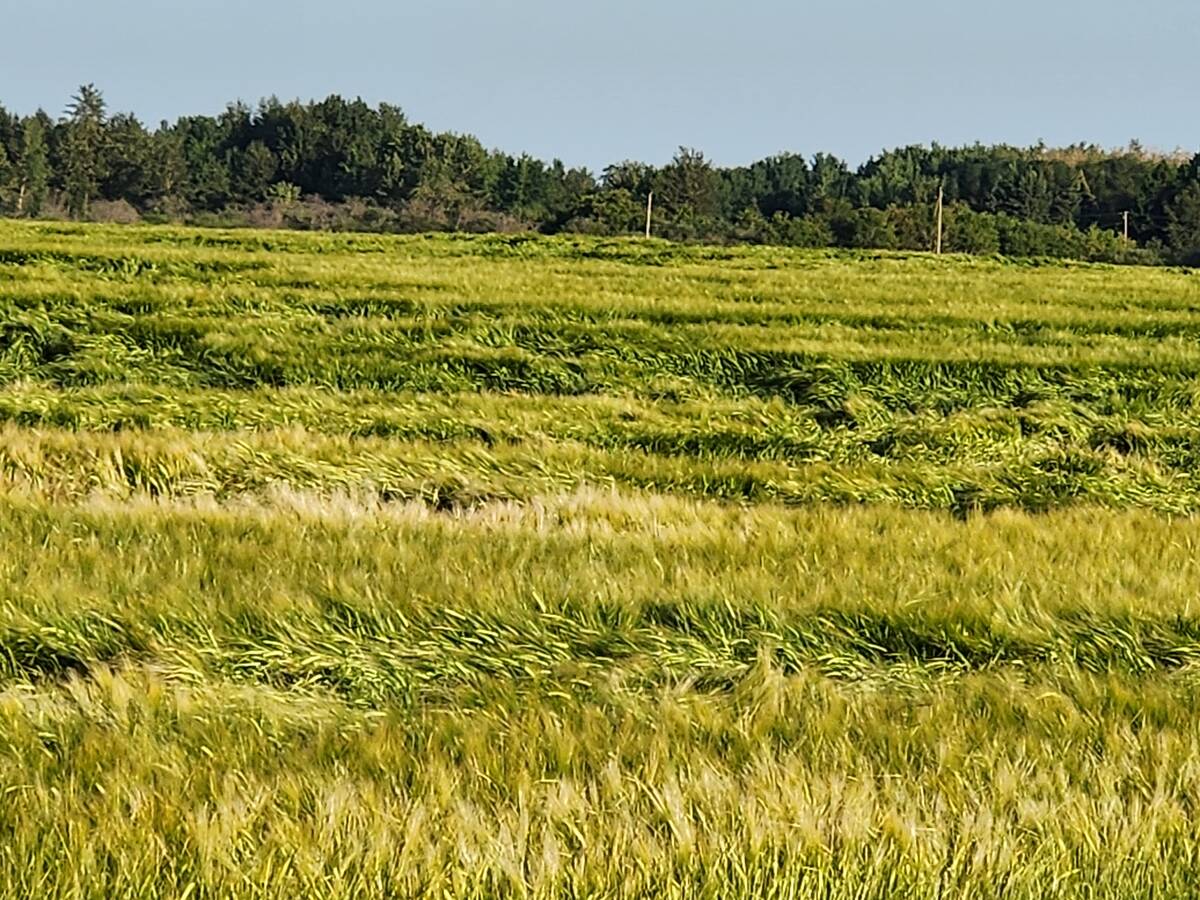
The field to the east, meanwhile, was very badly lodged and the crop itself was perhaps 10 days to two weeks behind in maturity. My simple diagnosis is that the field to the west had adequate soil copper reserves, whereas the soil to the east was copper-starved or deficient.
Copper’s function in production
There’s also the matter of disease. In the same wet weather, lodging can be accompanied by significant ergot infection of the grain heads, particularly in wheat and sometimes in barley.
Copper is essential for pollen fertility and for ergot prevention.
Two — yes, two — copper-based enzymes are needed for lignin biosynthesis that results in stem strength. Lignin is the “rod” that holds up the wheat stem, according to Horst Marschner’s book, Mineral Nutrition of Higher Plants.
Farmers have been removing crops from Prairie cropland for 100 to 150 years or more. As they deplete macronutrients, such as nitrogen, phosphate, potash and sulphur, they have soil tested and replaced them. What about the micronutrients every crop or cow also removes? Production draws down on micronutrient reserves. Can farmers accept that, in many soil types, their copper or perhaps zinc or manganese is critically low?
Minnesota potato grower recommendations state that for soils not in vegetable production within two years or where micronutrients are known to be low, farmers should put down five pounds an acre of manganese, three of zinc, four of iron, three of copper and 1.5 of boron.
“Use soil testing to monitor micronutrient status every two years to avoid micronutrient toxicity, because some micronutrients can build up in the soil,” the resource warns.
Now that you know you have been draining on-soil micronutrient reserves in grams per year as you harvest your crops, you must replace these missing reserves.
Most unfarmed sandy soils have one to two pounds of copper available in the top six inches of soil per acre and about two to three pounds of zinc. A 60-bushel crop of wheat will remove up to half an ounce of copper. How many cereal crops can you take off your cropland before you deplete your micronutrient reserves in your topsoil?
Livestock’s leavings and lodging
A common way to lodge a cereal crop is to place 15 to 25 tons of cattle manure onto sandy soil in particular. What usually happens, and I have heard it repeated many times, is that the cereal crop — especially wheat — has taken up too much nitrogen. I disagree.
The carbon:nitrogen ratio of such manure is about 30:1. Wheat straw is about 80:1. Thus, when manure is applied to cropland, it has a severe deficiency of nitrogen.
What really happens is that cropland soil per gram or ounce has billions of microorganisms such as fungi and bacteria. These microorganisms seize on the limited nitrogen, as well as other nutrients in the soil (potassium, phosphorus and sulphur) and including micronutrients such as boron, copper, zinc and manganese. The real cause of the lodging is the fact that the micronutrients take up the limited soil copper, depriving the wheat plants. Copper enzymes being essential for wheat stem strength, the result is crop lodging.
If you manure sandy soil, in particular, and your soil copper level is below 0.5 ppm, you must add copper to prevent lodging at around five lb. an acre (20 pounds of bluestone) and up your nitrogen (depending on existing soil nitrogen) by 60 to 100 pounds per acre.
I examined a sandy field of wheat in the Camrose, Alta., area that went 20 bushels an acre after a very heavy application of manure. The next year, the farmer applied, with a Valmar spreader, about four pounds of copper per acre (16 pounds of bluestone), drilled in some 60 pounds of nitrogen and seeded again to wheat. With the added copper and nitrogen, the field went 70 bushels an acre of No. 2 wheat.
Cereal growers must think like potato growers. Give the crop the optimum macro- and micronutrients in order to get an optimum target yield for your area.