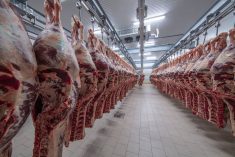



Chicago | Reuters – Chicago Mercantile Exchange (CME) hog futures sank on Thursday, with the most-active contract touching its lowest price in more than five months, as U.S. President Donald Trump ratcheted up tensions in a war of tit-for-tat tariffs with China.
Feeder cattle futures also slumped, and live cattle traded higher.
American hog farmers were hit after China, the world’s biggest pork consumer, imposed retaliatory tariffs on imports of U.S. pork last year as part of the trade war between the world’s two largest economies.
Read Also
U.S. urges WTO members to rethink core tariff rule in face of China threat
The Trump administration on Monday urged World Trade Organization members to rethink the body’s core principle of “Most Favored Nation” bound tariff rates, arguing in a new position paper that this has led to discriminatory practices and imbalanced trade, including with China.
Trump said on Thursday he would impose a 10 percent tariff on the remaining $300 billion of Chinese imports starting Sept. 1, after negotiators failed to make progress in U.S.-China trade talks this week.
Trump later told reporters he could further increase the tariff rate.
“If you ever thought there was going to be a positive relationship, the belief is that’s going south,” said Don Roose, president of Iowa-based broker U.S. Commodities.
CME August lean hog futures settled 2.525 cents lower at 76.800 cents per pound and touched their lowest price since July 9. Most-active October hogs tumbled 3.525 cents to 67.475 cents per pound and reached their lowest price since Feb. 20.
U.S. meat companies have been expecting that the deaths of millions of pigs in China from a fatal hog disease, African swine fever, will eventually prompt Chinese buyers to import more American pork.
China confirmed on Thursday a new outbreak of African swine fever in the central province of Hubei. The country has reported more than 140 outbreaks of the disease since the first case in August last year.
But the U.S. Department of Agriculture said in a weekly export sales report that China canceled purchases of 12,200 metric tons of U.S. pork for 2019 and 2,500 metric tons for 2020.
“It was a market that was fragile with huge supplies, hoping for demand news,” Roose said about CME hog futures. “We didn’t get the demand news.”
CME August live cattle futures rose 0.975 cent to 107.875 cents per pound. October live cattle gained 1.075 cents to 108.725 cents per pound.
CME August feeder cattle dipped 0.300 cent to 141.225 cents per pound. September feeders shed 0.925 cent to 141.525 cents per pound and hit the lowest price in more than a week.